State one business outcome—for example, “Charge an order once and confirm settlement”—and point Arcverin at your existing 50+ endpoint OpenAPI 2.0–3.2 file. No backend code rewrite required.
From Business Goal to Verified Agent Workflow · Arcverin
Turn a business goal and an API spec into one verified agent tool.
Instead of handing an AI agent 50+ raw REST endpoints and hoping it guesses the right call order, Arcverin compiles your business goal and OpenAPI spec into a bounded Arazzo 1.1 state machine, a unified WorkerIr graph, and a single compact MCP tool—100% offline by default.
Plain-English Overview · Zero Prompt Guesswork
How Intent-to-Workflow works in 10 seconds
Move retry logic, async polling, and safety checks out of fragile LLM prompts and into a deterministic state machine compiled before runtime.
Arcverin keeps only the 3 operations needed, clamps any missing tenant boundary, spend limit, or retry lookup to AR0 (Blocked) until an API owner confirms it, and compiles status polling and timeout checks deterministically.
Your agent invokes one compact tool (submit_order_payment) while low-level sub-calls, pre-retry GET reconciliation, and post-condition checks run inside the compiled workflow instead of the LLM context window.
100% offline & deterministic by default (no LLM required)
Intent profiling, execution-plan synthesis, contract checks, and compilation run locally with zero SaaS upload or API keys. An optional 11-provider BYOK Co-Pilot (OpenAI, Claude, Gemini, Bedrock, Azure, Ollama/vLLM) can assist with authoring, but it can never bypass deterministic gates or fill in unconfirmed security facts.
End-to-End Studio & Operations Flow
Where Intent-to-Workflow fits in Arcverin's 5-stage lifecycle
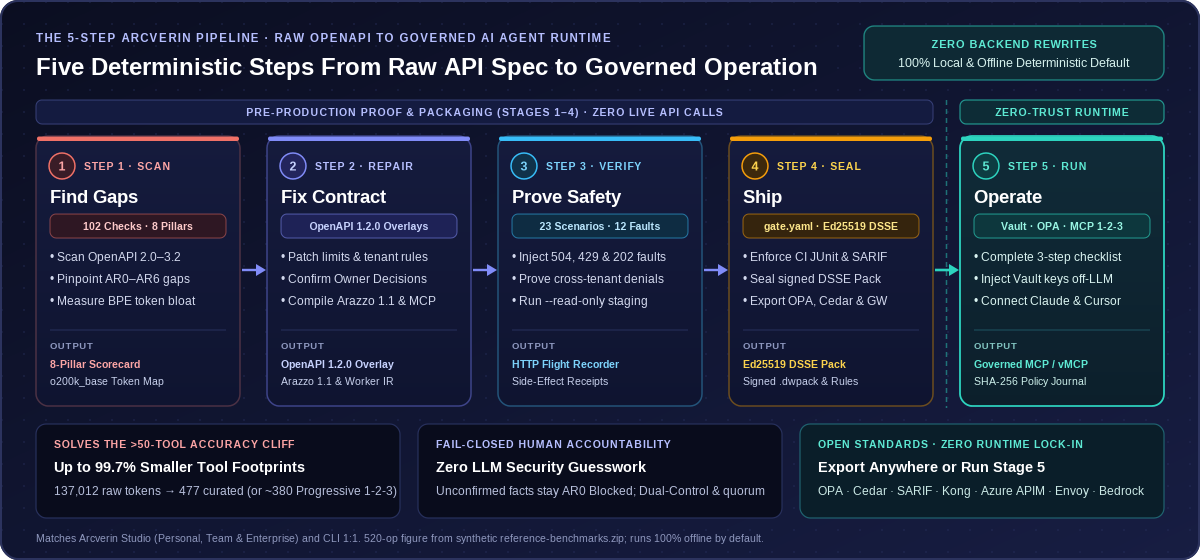
Intent-to-Workflow powers 1. Find Gaps and 2. Fix Contract, then hands the exact same compiled WorkerIr directly into 3. Prove Safety, 4. Ship, and 5. Operate.
-
1. Find Gaps — Scope intent & expose hidden API risks
Profile your goal against the OpenAPI spec to emit
intent.json, prune irrelevant endpoints, map blast radius across 8 readiness pillars and 102 checks, and measure exacto200k_baseMCP tool-description bloat. -
2. Fix Contract — Attest unknowns, patch Overlays & compile
Resolve
AR0(Blocked / Unsafe) slots via human Owner Decisions incapability.yaml, apply zero-regression OpenAPI1.2.0Overlays and Visual JDM Rules, and compileworkflow.arazzo.json,worker.ir.json, andmcp-tool.json(or Enterprise multi-providervMCP). -
3. Prove Safety — Fault-test the compiled state machine
Run the compiled
WorkerIragainst 23 multi-principal scenarios and 12 fault modes (dropped504s, stalled202jobs, duplicate/spoofed webhooks), validate read-only staging endpoints, or import digest-bound results from your own CI test harness. -
4. Ship — Enforce CI release gates & seal signed proof
Run Quick Ship (or
arcverin gate&pack build) to enforce fail-closedgate.yamlthresholds, export JUnit/SARIF, portable Arazzo1.1workflows, OPA Rego v1, AWS Cedar, Temporal skeletons/projects/Sagas, or gateway bundles, and seal an offline-verifiable Ed25519 DSSE Evidence Pack and.dwpackbundle. -
5. Operate — Bind Vault secrets & publish governed MCP
Complete Stage 5's 3-Step Readiness Checklist, bind credentials in the encrypted Vault outside LLM context, enforce dual-control Operator/Reviewer approvals and hash-chained OPA journals, and copy 1-click configs for Claude Desktop, Cursor, or VS Code.
Autonomy Governance & Pillar 4 Blast-Radius Controls
Autonomy Tiers (AR0–AR4) & Blast-Radius Guardrails
Every compiled workflow is clamped to the strictest Autonomy Tier supported by its verified OpenAPI 1.2.0 Overlay and Owner Decisions. Pillar 4 blast-radius controls and Pillar 5 idempotency guardrails prevent runaway spend, unbounded batch writes, and retry storms.
| Autonomy Tier | Plain-English Meaning | Pillar 3/4/5 Isolation, Limits & Retry Controls | OpenAPI 1.2.0 Overlay & Runtime Behavior |
|---|---|---|---|
AR0 (Blocked / Unsafe) |
Missing contract metadata or unresolved risk; execution is prohibited fail-closed. | Unverified auth scopes, tenant ambiguity (Pillar 3), missing cost/batch limits (Pillar 4), or missing idempotency (Pillar 5). | Blocked from promotion by gate.yaml and arcverin-runtime until resolved by an overlay or Owner Decision. |
AR1 (Observe / Read-Only Safe) |
Non-mutating GET, HEAD, and OpenAPI 3.2 safe, idempotent QUERY (IETF RFC 10008) inspection with zero declared side effects, strictly scoped to the caller's tenant. |
x-arcverin-context.tenantBoundary (schema v1.1.0), pagination & query-body maximum caps, and read rate/concurrency guards. |
Eligible for read-only staging validation and autonomous read-only Daemon reconciliation; pre-3.2 query keys and unknown verbs remain clamped fail-closed. |
AR2 (Execute with Human Approval) |
High-impact mutation requiring explicit human step-up approval before firing. | Pillar 4 maximum spend/record caps, rate/concurrency guards, and x-arcverin-context (tenantBoundary & recovery). |
Pauses at a stateful Actor approval checkpoint; OPA/Cedar policies reject unapproved execution. |
AR3 (Bounded Autonomous Execute) |
Autonomous mutation bounded by strict financial, concurrency, and retry ceilings. | Enforced schema maximum spend/record caps (Pillar 4), rate/concurrency guards, Pillar 5 recovery pre-retry GET lookup, and Pillar 6 async 202 polling bounds. |
Executes without human pause only within numeric maximum limits and verified idempotent retry paths. |
AR4 (Verified Autonomous Loop) |
End-to-end autonomous loop with deterministic pre-checks and post-condition verification. | All Pillar 3/4/5 caps plus mandatory post-condition verification query (Pillar 7) and bounded async 202 state tracking (Pillar 6). |
Confirms final resource state via post-condition lookup and seals tamper-evident receipts in policy-journal.jsonl. |
Stage 1 offline qualification (arcverin-qualify and Studio's clickable Gate Ladder) evaluates specs on the 7-rung Qualification Assurance Lattice (AR0–AR6) and maps deterministically onto these 5 Runtime Execution Tiers (AR0–AR4). See the normative AR0–AR6 → AR0–AR4 crosswalk.
Pillar 4 Blast-Radius Controls
Arcverin enforces numeric schema maximum spend and record caps, request rate and concurrency guards, and bounded async 202 polling ceilings directly in the compiled capability plan—stopping runaway loops before upstream APIs are hit.
Tenant Boundary & Pre-Retry Reconciliation
Schema-validated x-arcverin-context (schemaVersion: "1.1.0", tenantBoundary, and recovery) pairs with compiled Arazzo 1.1 pre-retry GET lookups so every call stays scoped to the authenticated tenant and reconciles state after 504 timeouts before any retry runs.
4-Step Ahead-of-Time Compiler · 1:1 Studio & Headless CLI Parity
Inside the 4-Step Deterministic Intent-to-Workflow Pipeline
Also documented as the Intent-to-Goal pipeline in Whitepaper WP-06, every step runs 100% offline and deterministically from Studio or your CI runner to turn a plain-English goal and OpenAPI 2.0–3.2 spec into a verified state machine.
Step 1 · Intent Profiling
arcverin intent profile → intent.json
Matches a plain-language goal (such as “Charge order once and confirm settlement”) against a local OpenAPI 2.0–3.2 spec offline. Selects only the candidate operations needed for that outcome, prunes unrelated endpoints, and flags missing tenant isolation, idempotency, or limit declarations.
Step 2 · Execution Plan Synthesis
plan create → plan validate → plan.json
Converts intent.json into a structured execution plan with explicit inputs, call sequencing, and completion checks. Any state-changing operation with unresolved safety metadata stays clamped fail-closed at AR0 (Blocked) rather than letting an LLM guess.
Step 3 · Contract, Attestation & Overlays
arcverin.capability/v1 + OpenAPI 1.2.0 Overlays
Wraps the plan into capability.yaml using explicit {value | unknown} slots. Unconfirmed auth schemes, spend caps, tenant boundaries, or retry lookups stay blocked until an API owner attests them (placeholders like "TBD" are rejected), while non-destructive OpenAPI 1.2.0 Overlays patch spec gaps with automatic rollback if readiness drops.
Step 4 · Synchronized Compilation
workflow.arazzo.json + worker.ir.json + mcp-tool.json
Lowers the attested contract and overlaid spec into three synchronized files: a standard Arazzo 1.1 workflow DAG (extended on Enterprise to cross-provider vMCP DAGs with strictest-tier autonomy inheritance), a unified WorkerIr graph executed identically by Stage 3 simulation and Stage 5 Rust runtime, and a single goal-oriented MCP tool descriptor.
# 1. Profile business intent against the OpenAPI spec offline
arcverin intent profile openapi.json "Charge order once and confirm settlement" --output ./out --service-slug orders --run-name pilot

# 2. Synthesize & validate a deterministic execution plan
arcverin plan create ./out/orders/intent/pilot/intent.json --output ./plan --base-url https://api.staging.example.com
arcverin plan validate ./plan/orders/plan/pilot/plan.json

# 3. Create Capability Contract, resolve AR0 unknowns via Owner Decisions & apply Overlays
arcverin capability new --spec openapi.json --outcome "Charge order once and confirm settlement"
arcverin decisions list capability.yaml
arcverin decisions answer capability.yaml --ref DEC-ISOL-001 --value "auth.tenant_id" --attested-by "platform-security"

# 4. Compile synchronized Arazzo 1.1 DAG, WorkerIr runtime graph & compact MCP tool
arcverin capability compile capability.yaml
Output artifacts include intent.json, plan.json, capability.yaml, overlay.yaml, workflow.arazzo.json, worker.ir.json, and mcp-tool.json. See the Blast Radius & Compilation Reference and WP-06 (PDF) for the full tier and schema matrix.
Why it matters architecturally
Eliminates runtime orchestration guesswork
Sequencing a POST mutation, polling a 202 Accepted status endpoint, running a GET reconciliation check after an HTTP 504 timeout, and verifying post-conditions happen deterministically in compiled workflow steps—not stochastically across LLM turns.
Compacts agent context without losing capability
Collapsing granular sub-calls behind one business-outcome tool (such as submit_order_payment or restore_cluster_service) trims MCP tool-description payloads by up to 99.7% on synthetic 520-operation catalogs (o200k_base) and avoids the >50-tool selection accuracy cliff.
Keeps design, fault proof & runtime aligned
Because intent → plan → capability compiles to one WorkerIr, the exact state machine fault-tested against commit-then-drop-response or delayed-webhook failures in Stage 3 is the exact state machine executed by the Stage 5 Rust runtime.
Practical engineering caveats to keep in mind
1. Offline lexical matching still requires engineer review: Because deterministic intent profile selects candidate endpoints from OpenAPI paths, operation IDs, and descriptions without an LLM, engineers should review intent.json and plan.json on poorly named or ambiguous specs (or refine endpoint selection in capability.yaml or with optional BYOK Co-Pilot).
2. A compiled workflow is not immediately runnable: Generating plan.json or workflow.arazzo.json is strictly a design-time step. Live traffic still requires owner attestations, Stage 3 verification (arcverin validate across mock, read-only staging, or customer-run test imports), signed DSSE packaging (arcverin pack), encrypted Vault credential binding, and Stage 5 commissioning approval.
3. Standard Arazzo portability vs. Arcverin runtime guardrails: Standard API steps, polling loops, and pre-retry GET lookups compile into standard Arazzo 1.1 steps and expressions, while Arcverin-specific runtime guardrails travel in x-arcverin-dw-* extensions (paired with x-arcverin-context v1.1.0 tenantBoundary and recovery metadata in Overlays). Third-party Arazzo runners execute standard steps while ignoring custom x-arcverin-dw-* extensions unless you also enforce exported OPA Rego v1, AWS Cedar, or gateway policies.
Three execution patterns for any business task
Not every agent action is a single quick request. Compiled WorkerIr supports three bounded execution patterns with built-in limits and approvals.
Single · One complete action
Run a multi-step capability once, verify that the business outcome succeeded, and record a receipt.
Example: Submit a payment with duplicate protection, check status on timeout, and confirm the order is settled.
Actor · Long-running job with approval
Track a stateful case across checkpoints while waiting for a background job or AR2 human step-up approval pause/resume.
Example: Run a cluster pre-check, pause for a human engineer's approval, trigger the restore, poll until finished, and verify cluster health.
Daemon · Scheduled reconciliation & event loops
Repeat a read-only check, webhook reconciliation, or status loop on a schedule within strict rate and cost limits.
Example: Periodically check pending background orders and record an auditable reconciliation summary.
Every execution pattern enforces the limits, permissions, and verification checks defined in your Capability Contract.
Three ways to test before release
Choose the testing path that fits your environment—keeping offline simulation, read-only staging checks, and customer-run backend test imports clearly distinct in your signed Evidence Pack.
1. Built-in failure simulator
Test your compiled WorkerIr locally against a stateful mock server with an in-memory side-effect ledger across 23 scenarios and 12 network failure modes.
2. Read-only staging checks
Validate live read behavior against approved non-production staging servers using encrypted Vault credentials and an automatic guard that blocks any data-modifying calls.
Vault & staging guide3. Portable customer test suite
Export a test suite to run against your own backend service and scheduler so you verify how many real jobs your service created, then import tamper-checked results back into Arcverin for release gating.
Workflows & validation guideTwo core rules that prevent costly agent mistakes
- Never guess when a rule is unknown: If an API's side effects, tenant boundaries, or verification steps are missing, Arcverin blocks high-risk execution until an owner confirms them.
- An HTTP 202 or cancellation is not a rollback: Accepting a request or canceling a task never proves what changed on the server—Arcverin workflows check actual resource status before retrying.
Key concepts in plain English
- OpenAPI & Overlays
- OpenAPI is the standard file that describes your REST endpoints. An OpenAPI Overlay is a non-destructive patch file that adds missing readiness constraints and descriptions without altering your original code.
- Capability Contract
- The central blueprint that ties one or more API endpoints to a business outcome—defining permissions, retry protection, cost limits, and verification steps.
- Owner Decisions & Rules
- Guided sign-offs under 2. Fix Contract where service owners clear
AR0(Blocked / Unsafe) items to promote capabilities acrossAR1–AR4, paired with the top-bar Rules pill (102 Built-in Readiness & Token Rules & Enterprise Custom Visual JDM Rules). - Arazzo Workflow, WorkerIr & Virtual MCP (vMCP)
- An open standard for describing multi-step API sequences—compiled alongside
worker.ir.json(the singleWorkerIrstate machine shared by Stage 3 fault testing and Stage 5 runtime)—plus Enterprise multi-provider Virtual MCP (vMCP) 7-domain blueprints (Option A: Account Compromise & Option B: Employee Offboarding). - Curated MCP Tool & 3-Step Operations Checklist
- A compact, goal-focused tool cutting MCP tool-description tokens by up to 99.7% on synthetic 520-op catalogs, published in 5. Operate via the 3-Step Readiness Checklist (Connect Vault → Check Readiness → Publish MCP).
- Evidence Pack & Release Gate
- An automated pass/fail policy check for CI pipelines and a cryptographically signed bundle containing your spec, scorecard, rules, and test results for security sign-off.
Turn one risky endpoint into a verified capability.
Start locally on Windows x64 or Linux Ubuntu 26.04 x64 with a $99 1-Month Pass or $49/mo billed annually ($588/yr) license. Then verify your Personal license to upgrade to Team or Enterprise on Docker and Kubernetes.