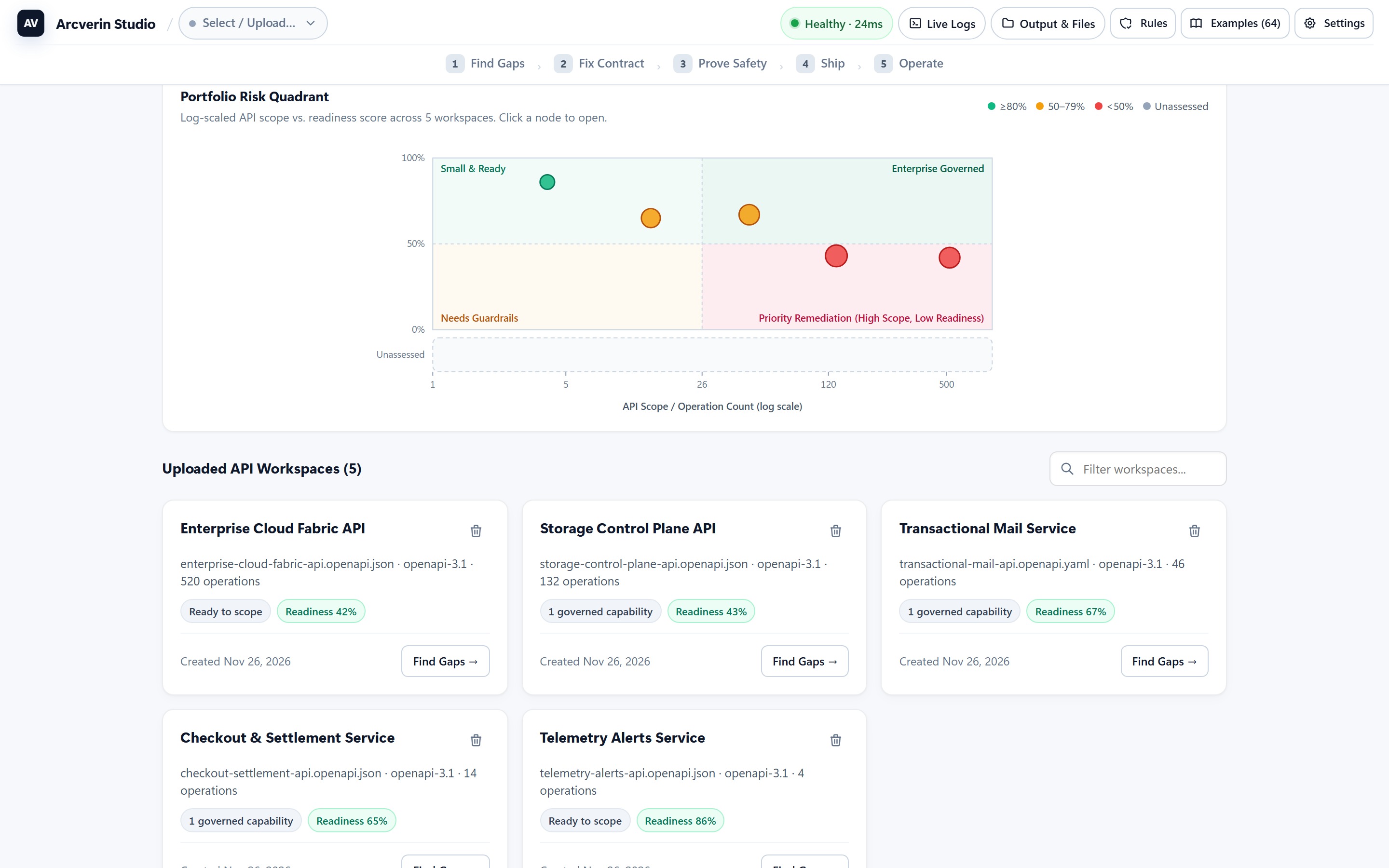
Welcome to Arcverin Studio, where raw OpenAPI specs become safe, compact, verified AI agent capabilities across five guided stages. Start on the Portfolio Risk Quadrant to compare scope against readiness across every workspace and spot high-risk APIs needing priority remediation locally.
Use these 12 real captures to navigate every core workflow in Studio and Operations.
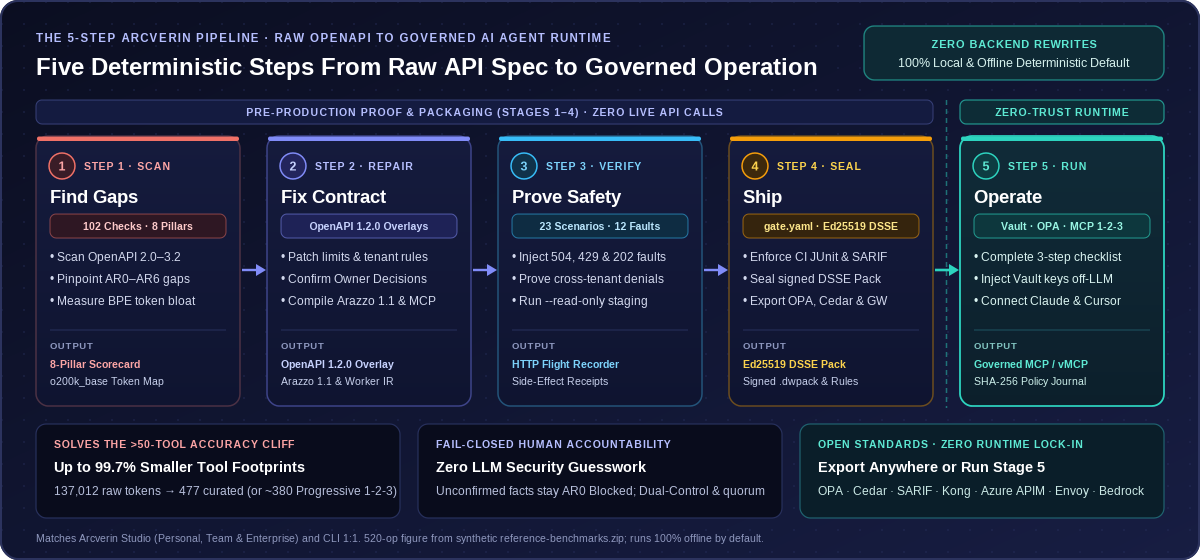
Personal, Team, and Enterprise Editions all share the unified 1. Find Gaps → 2. Fix Contract → 3. Prove Safety → 4. Ship → 5. Operate lifecycle—running 100% locally and deterministically with zero live provider calls during design, repair, or fault simulation.
Walk chronologically through all 11 design, qualification, compaction, simulation, gating, and compliance screens captured from a running local Arcverin Studio installation.
Overview · Studio Home & Multi-API Portfolio Risk Quadrant
01Prioritize API workspaces on the Portfolio Risk Quadrant
Arcverin Studio running locally via arcverin-studio serve with 5 synthetic, vendor-neutral OpenAPI 3.1 reference workspaces (reference-benchmarks.zip).
Open full image ↗Actual Arcverin Studio interface · Multi-API Portfolio Risk Quadrant separating Small & Ready (86%) from high-scope Priority Remediation workspaces (42%–43%).
Do
Upload one or more OpenAPI 2.0–3.2 specs and review the log-scaled Portfolio Risk Quadrant across your entire API estate.
Click any high-scope red node in Priority Remediation (or click Find Gaps → on its workspace card) to drill straight into Stage 1.
Instead of auditing APIs in ad-hoc spreadsheets, Studio plots every workspace by log-scaled operation count vs. deterministic 8-pillar readiness—surfacing the largest, riskiest API surfaces first with zero live provider calls.
Check before continuing
Personal, Team, and Enterprise Editions all share the unified 1. Find Gaps › 2. Fix Contract › 3. Prove Safety › 4. Ship › 5. Operate pipeline.
Next
Open Examples (64) to compare real before-and-after API hazard showcases locally, or jump straight into Stage 1.
Examples (64) · Customer API Hazard & Showcase Library
02Explore 64 before-and-after API hazard showcases locally
Opened via the top-bar Examples (64) button in Studio.
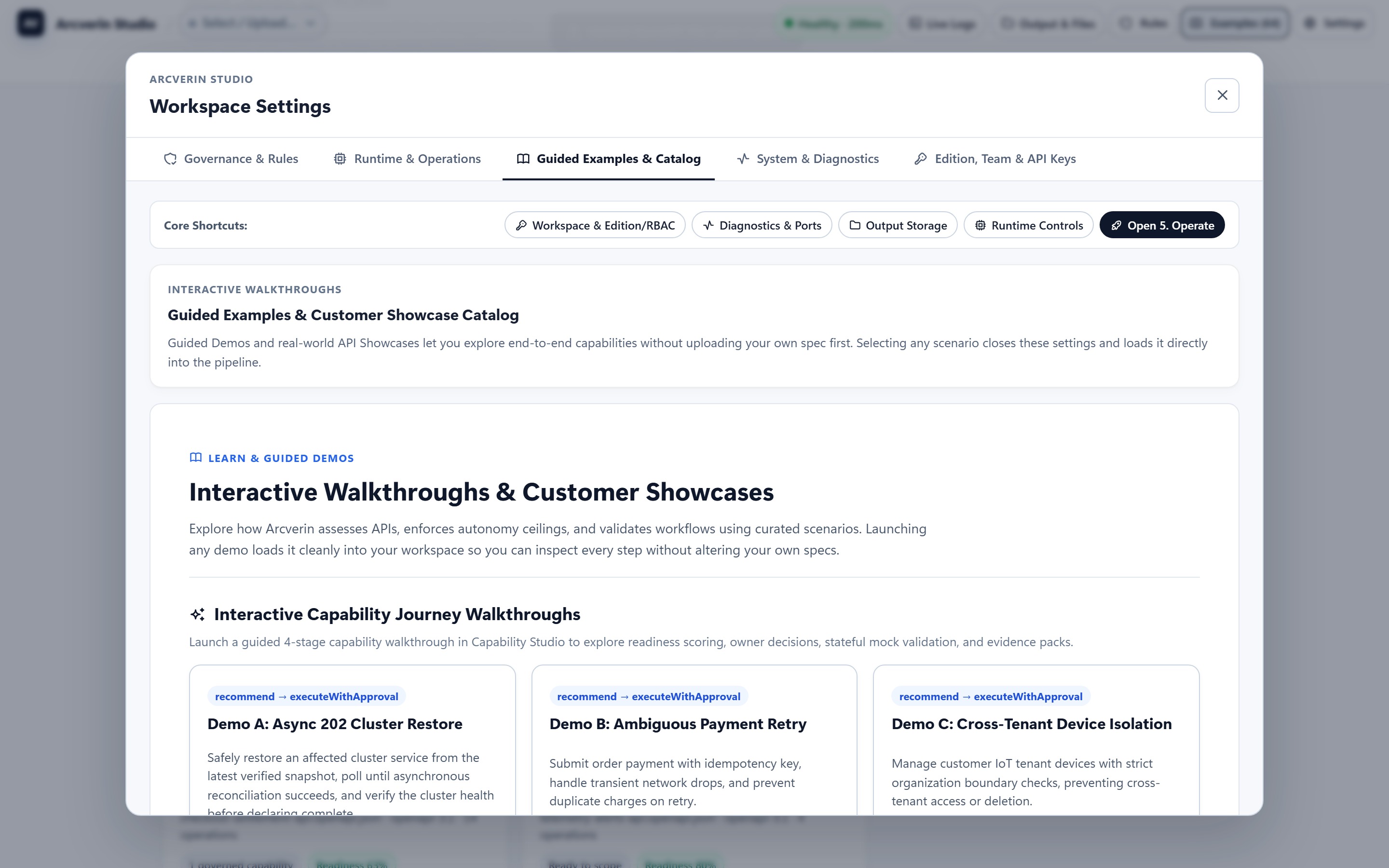
Open full image ↗Actual Arcverin Studio interface · Examples (64) Customer Showcase Library covering 64 cases, 486 verification steps, and one-click Before/After specs.
Do
Launch one of the 3 guided hazard demos (Cluster Restore 202 Async, Double-Charge 504 Retry, Cross-Tenant Data Leak) or filter all 64 cases by category.
Load any case's Before and After OpenAPI specs locally to see how deterministic overlays and workflows repair real failure patterns.
Examples (64) gives teams 64 reproducible teaching and verification showcases completely offline—proving every failure mode without exposing internal specs or calling external hosts.
Check before continuing
Loading a showcase inspects it locally and never sends data outside your workstation or cluster.
Next
Open a workspace under 1. Find Gaps to inspect the 8-Pillar Readiness Radar and AR0–AR6 Autonomy Gate Ladder.
03Pinpoint exact readiness blockers on the 8-Pillar Radar & Gate Ladder
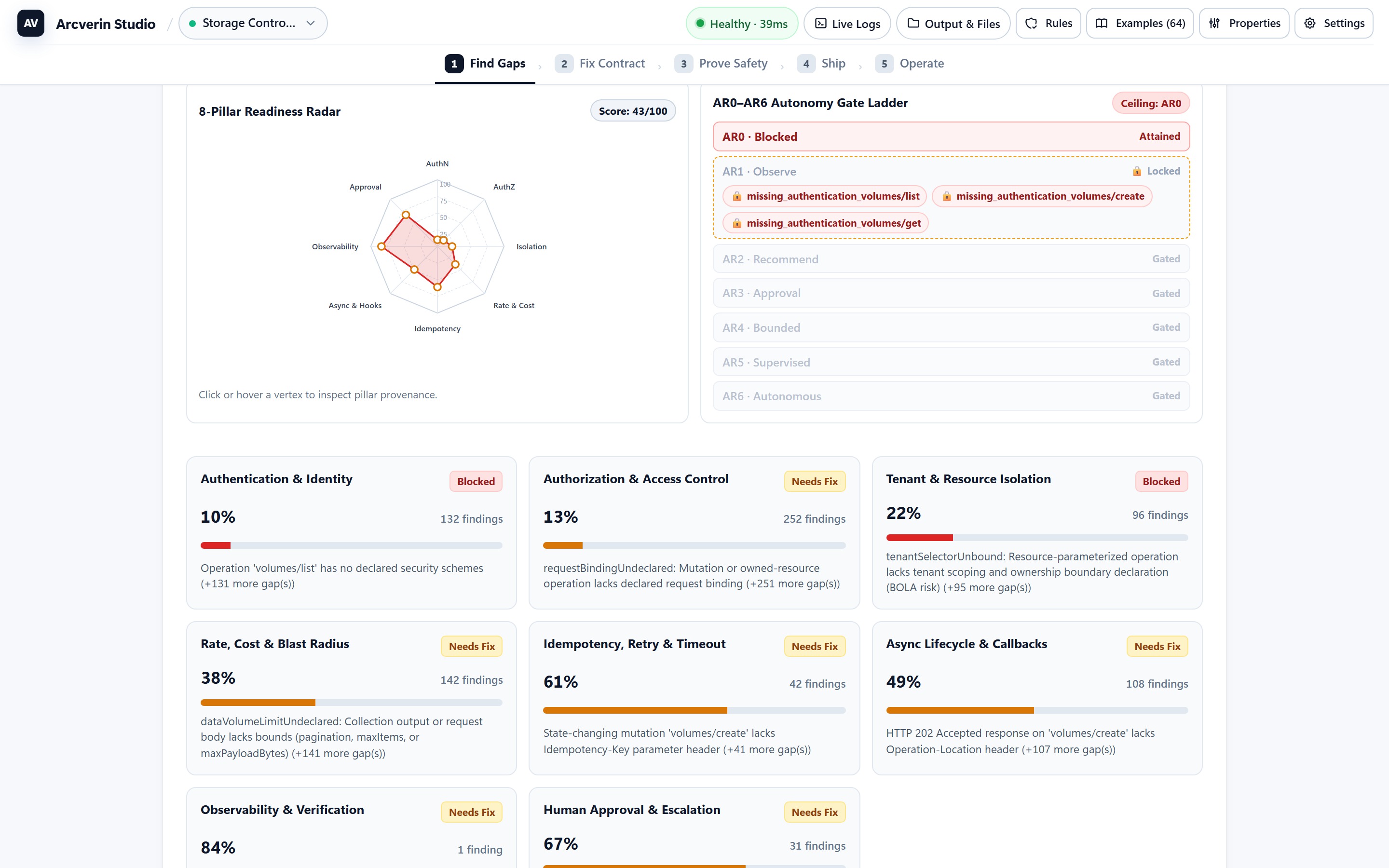
Completed offline Stage 1 assessment on Storage Control Plane API (132 operations).
Open full image ↗Actual Arcverin Studio interface · 8-Pillar Readiness Radar (43/100) paired with the AR0–AR6 Autonomy Gate Ladder showing exact lock findings clamping execution at AR0 · Blocked.
Do
Inspect the 8-Pillar Readiness Radar polygon to see which pillars drag readiness down (e.g., Authentication 10%, Authorization 13%, Tenant Isolation 22%).
Check the AR0–AR6 Autonomy Gate Ladder to see the exact lock findings blocking promotion to AR1 and above.
Arcverin enforces fail-closed {value | unknown} semantics: missing auth schemes, unbound tenant identifiers, or missing idempotency headers deterministically clamp high-risk operations at AR0 Blocked instead of letting an AI model guess. Stage 1 renders the 7-rung Qualification Gate Ladder (AR0 Blocked, AR1 Observe, AR2 Recommend, AR3 Approval, AR4 Bounded, AR5 Supervised (Read), AR6 Autonomous), which maps deterministically onto the 5 Runtime Execution Tiers (AR0–AR4) enforced in Stages 2–5 and the Control-Plane API (notably Qualification AR3 · Approval → Runtime AR2 · Execute with Human Approval, and Qualification AR4 · Bounded → Runtime AR3 · Bounded Autonomous) — see the full AR0–AR6 → AR0–AR4 crosswalk.
Check before continuing
Click any radar vertex or pillar card to trace each finding back to exact OpenAPI paths and operation IDs.
Next
Scroll down to Axis 2 to measure your exact o200k_base MCP Token Economy footprint.
1. Find Gaps · Axis 2 MCP Token Economy Cliff
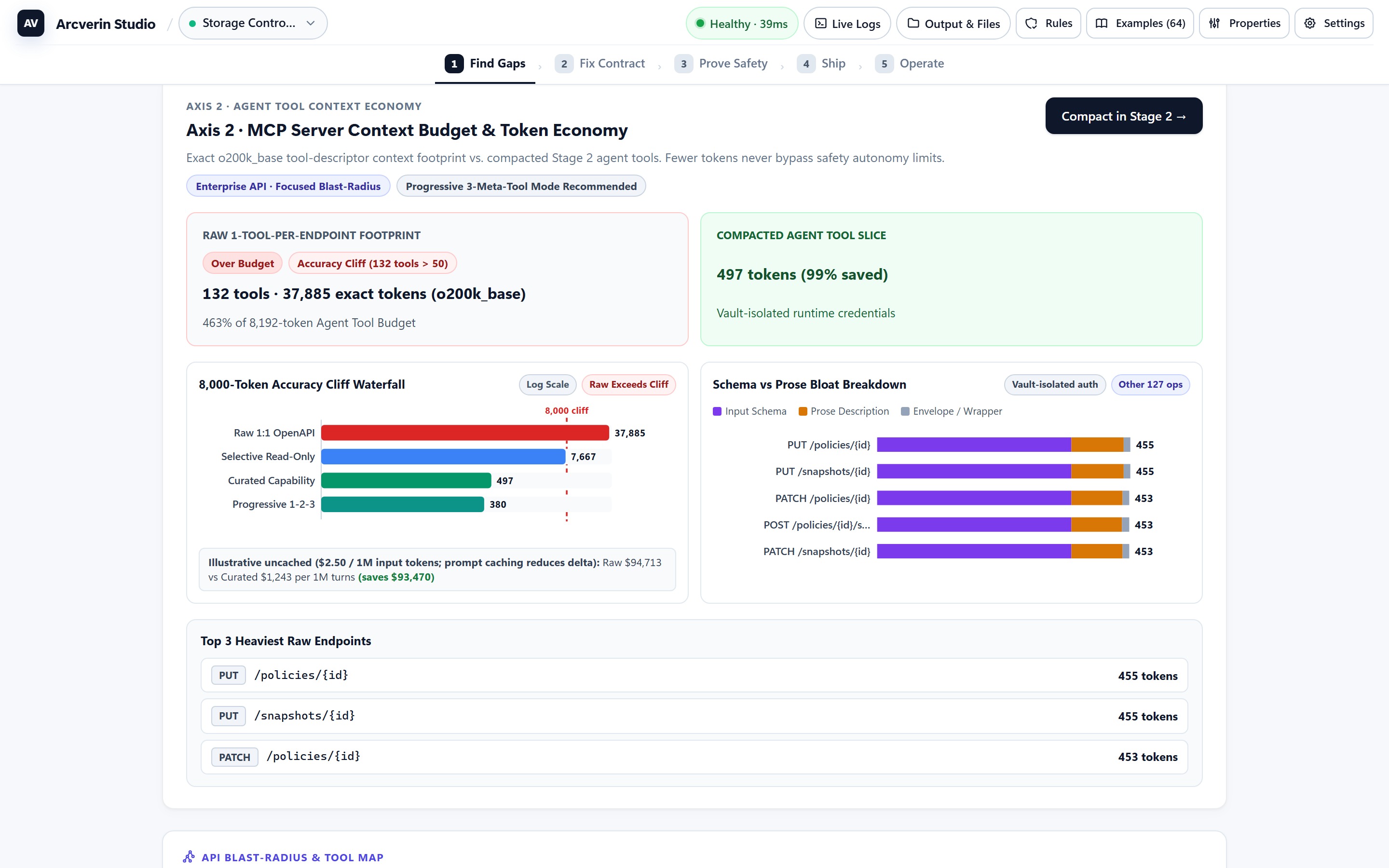
04Measure exact o200k_base token bloat on the Log-Scale Accuracy Cliff
Axis 2 MCP Server Context Budget & Token Economy on Storage Control Plane API (132 operations).
Open full image ↗Actual Arcverin Studio interface · Axis 2 Log-Scale Accuracy Cliff comparing Raw 1:1 OpenAPI (37,885) vs. Selective Read-Only (7,667), Curated Capability (502, 99% saved), and Progressive 1-2-3 (380), plus Schema-vs-Prose bloat.
Do
Compare Raw 1-tool-per-endpoint token cost against the 8,000-Token Accuracy Cliff and verify how Curated and Progressive 1-2-3 tiers bring prompts safely under budget.
Inspect the Schema vs Prose Bloat Breakdown and Top 3 Heaviest Raw Endpoints to identify verbose descriptions and oversized input schemas.
Measured on synthetic, vendor-neutral OpenAPI 3.1 reference fixtures (reference-benchmarks.zip, not customer production savings); every token count uses exact o200k_base BPE parity between Studio and arcverin mcp-economy. Compaction eliminates the 50-tool LLM selection cliff (which prompt caching does not fix) while never bypassing safety autonomy limits. The in-panel dollar figure is an illustrative uncached baseline ($2.50 / 1M input tokens); prompt caching reduces dollar savings proportionally—model your own cache rate in the Break-Even Calculator.
Open Rules in the top bar to inspect all 102 built-in safety and token-economy checks.
Rules · 102 Built-In Deterministic Checks
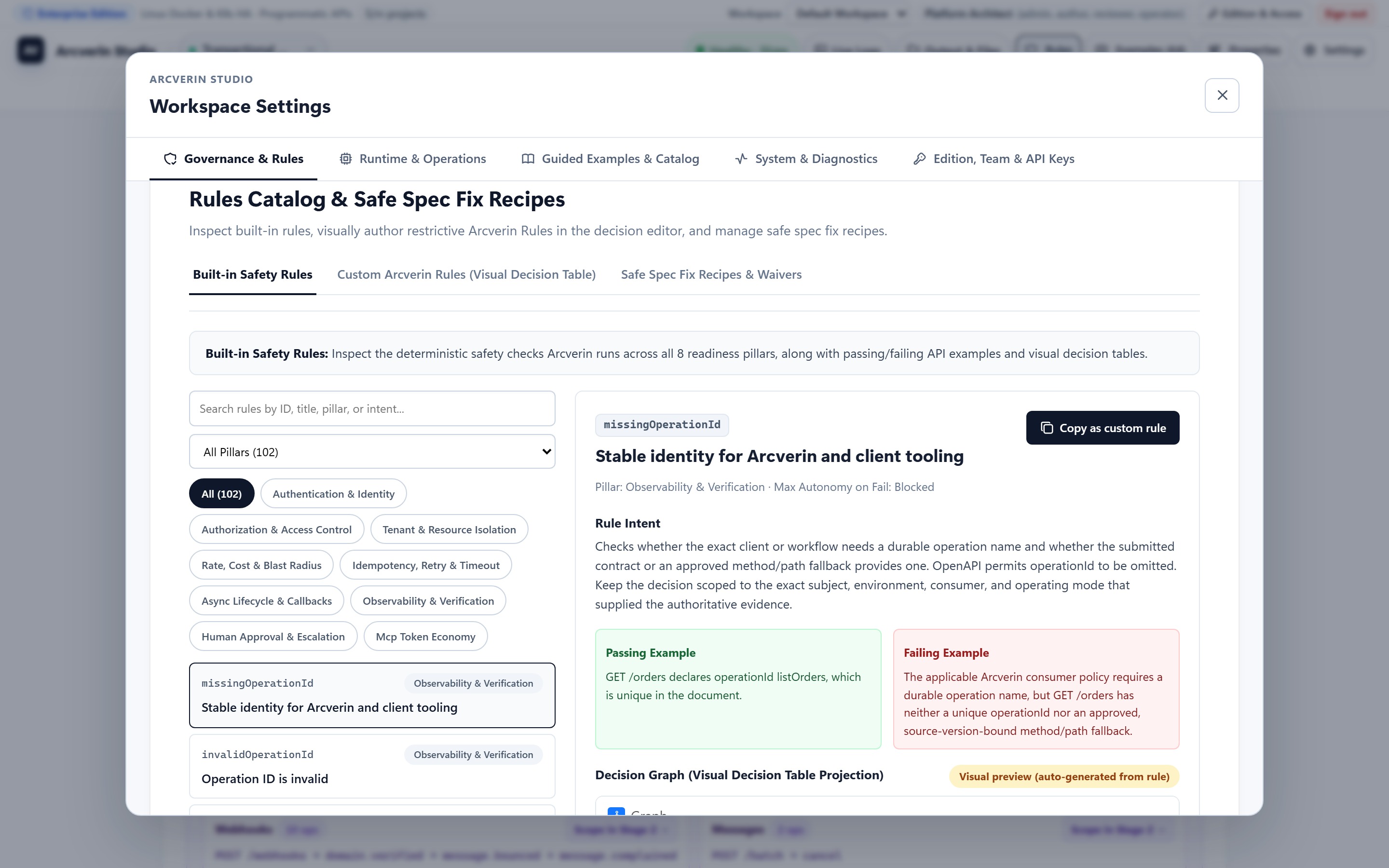
05Inspect all 102 built-in readiness and token-economy rules
Opened via the top-bar Rules button in Studio.
Open full image ↗Actual Arcverin Studio interface · Built-in Safety Rules catalog inspecting rule intent, pillar filters, passing/failing examples, and one-click Copy as custom rule.
Do
Filter by any of the 8 readiness pillars or search by rule ID, title, or security intent across all 102 built-in checks.
Review Safe Spec Fix Recipes & Waivers or click Copy as custom rule to extend a rule inside Enterprise Visual Policy Studio.
Every edition runs the exact same 102 authoritative deterministic checks (97 readiness + 5 MCP token economy) as a non-weakening floor across Studio and CI pipelines.
Switch to the Custom Arcverin Rules (Visual Decision Table) tab to author Enterprise policies visually.
Enterprise Policy · Visual Policy Studio (Custom JDM)
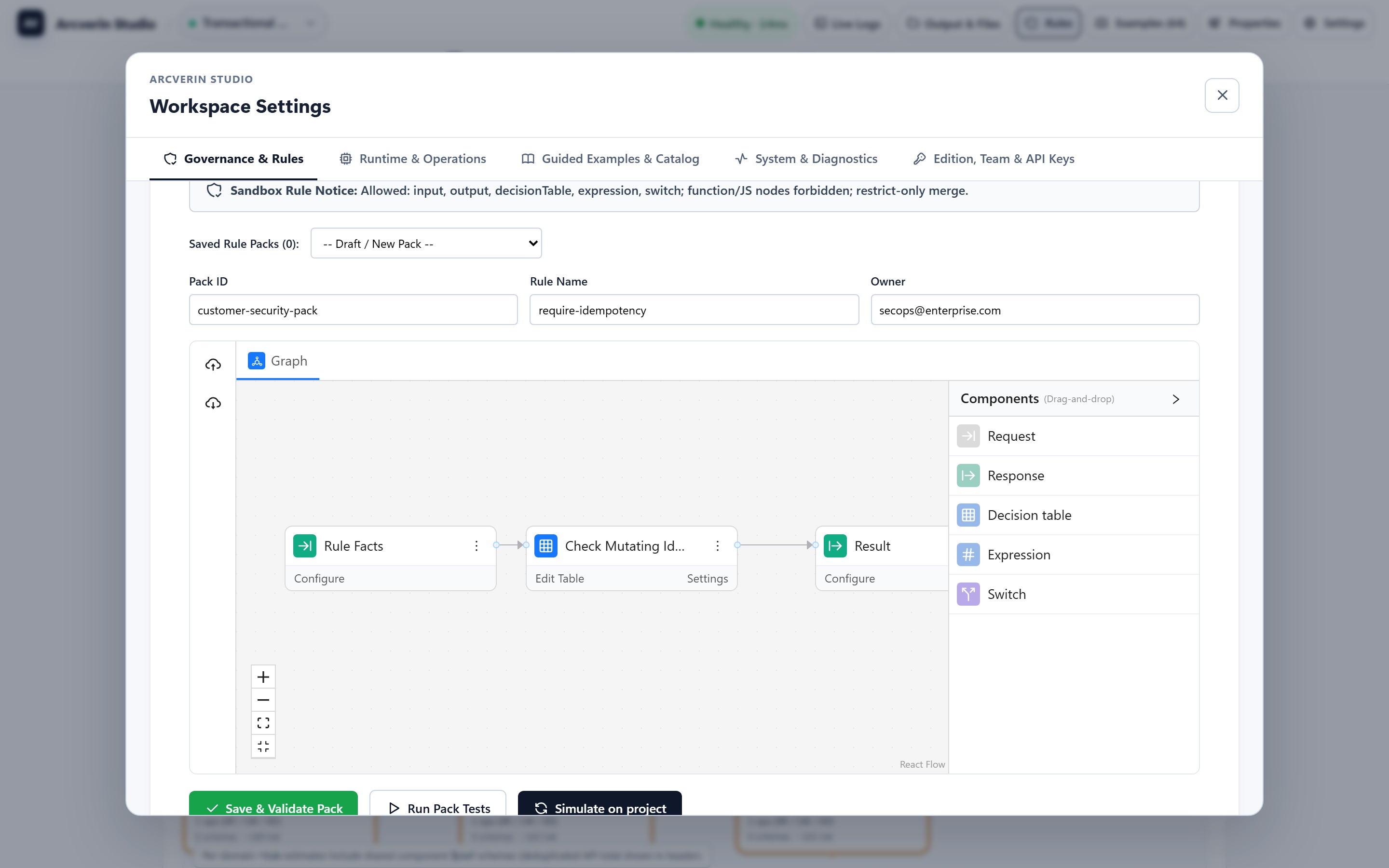
06Author Custom Visual JDM Decision Tables in a restrict-only sandbox
Enterprise Edition organization rules active in Studio.
Open full image ↗Actual Arcverin Studio interface · Enterprise Visual Policy Studio with drag-and-drop Components palette and zero-script Sandbox Rule Notice.
Do
Drag Request, Decision table, Expression, Switch, and Response nodes onto the visual graph to express internal security standards.
Validate, unit-test, and simulate your custom rule pack across your API portfolio—and verify in CI via arcverin rules pack test.
Enterprise Visual Policy Studio disables arbitrary JS/script execution (function/JS nodes forbidden; restrict-only merge) so platform teams enforce organization policies safely across every workspace without weakening built-in checks.
Check before continuing
Every custom rule pack is versioned and included inside Stage 4 Evidence Packs for auditability.
Next
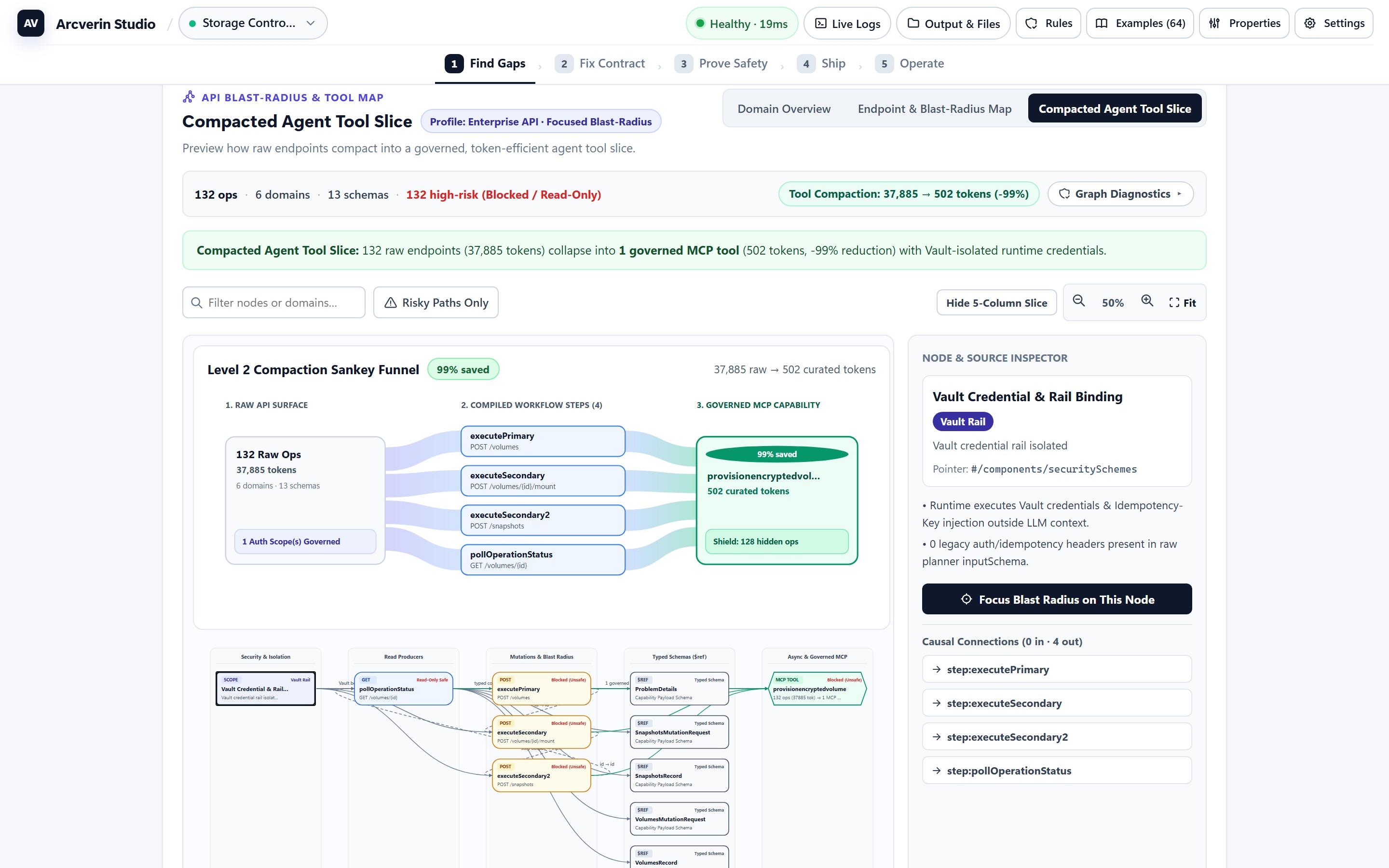
Inspect the Level 2 Compaction Sankey Funnel in Stage 1 to verify how raw endpoints collapse into a governed MCP slice.
The Sankey Funnel proves visually to AI architects and security reviewers that agents never see raw destructive endpoints or secret headers—only the bounded, compiled MCP capability surface.
Check before continuing
Verify that every required mutation step flows through typed schemas and Vault-bound execution rails.
Next
Move to 2. Fix Contract to scope operations, preview non-destructive OpenAPI 1.2.0 Overlays, and compile your capability.
2. Fix Contract · OpenAPI 1.2.0 Overlay & Capability Studio
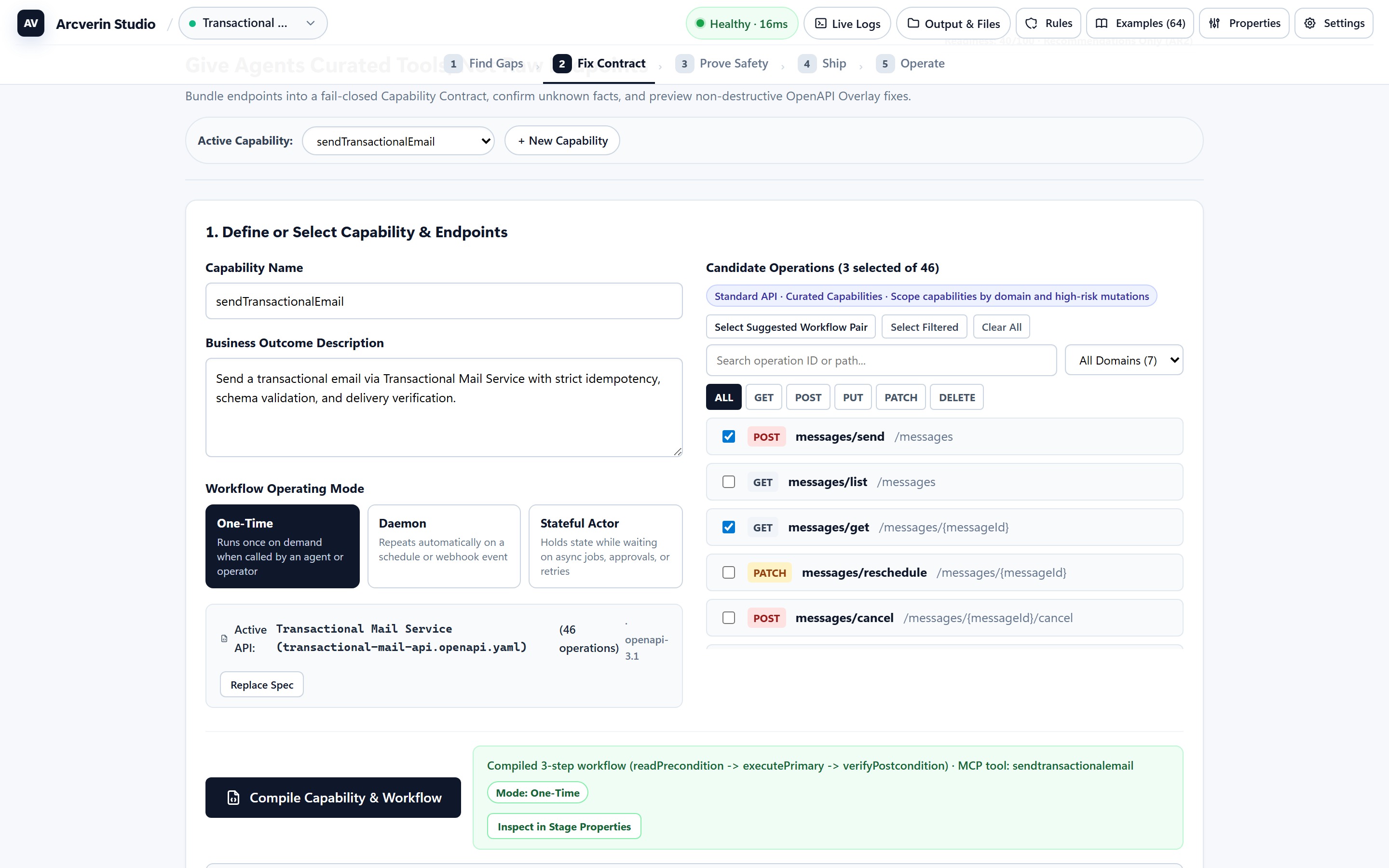
08Scope operations and compile an Arazzo 1.1 workflow & MCP tool
Stage 2 compilation on Transactional Mail Service (3 of 46 operations scoped into sendTransactionalEmail → MCP tool sendtransactionalemail).
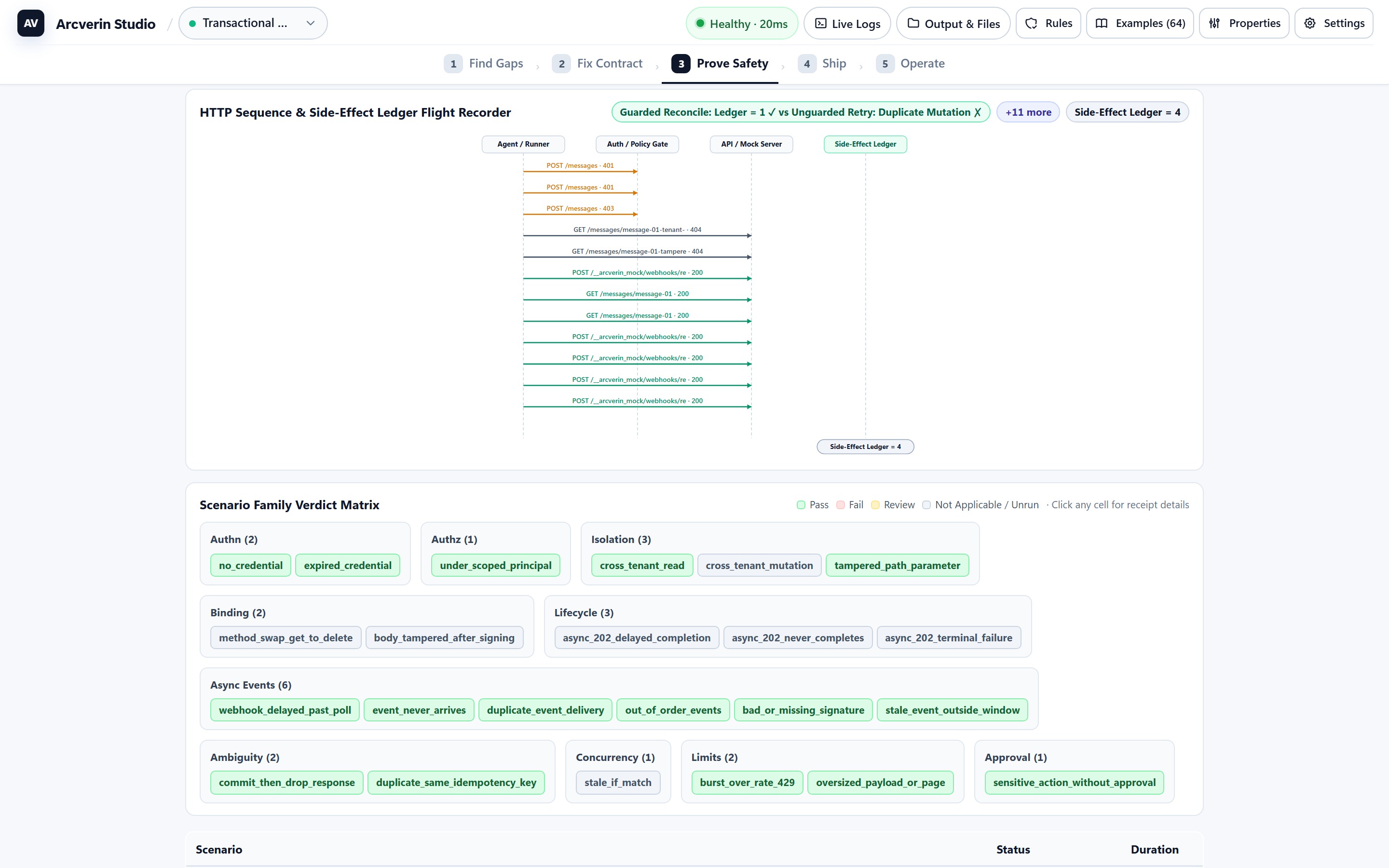
09Prove retry, isolation, and webhook resilience offline
Executed Stage 3 validation on Transactional Mail Service (send_transactional_email) against the local stateful mock.
Open full image ↗Actual Arcverin Studio interface · Executed 3. Prove Safety Flight Recorder, Side-Effect Ledger = 4, and 10-family Scenario Family Verdict Matrix (16 passing / 7 unrun scenarios in this partial run) verifying auth, isolation, async events, 504 ambiguity, rate limits, and approval checks with zero live calls.
Do
Click Run Safety Validation to exercise your compiled capability across 23 stateful scenarios and 12 fault-injection modes locally (or run read-only staging checks).
Inspect the HTTP Flight Recorder trace and click any cell in the Scenario Family Verdict Matrix (Authn, Authz, Isolation, Async Events, Ambiguity, Limits, Approval) to inspect exact receipts.
Every behavioral claim is backed by an executed test receipt before a live agent touches production—catching double-billing on HTTP 504 drops, cross-tenant BOLA, burst 429 limits, and duplicate webhook replays offline.
Check before continuing
Scenarios that have not passed remain explicitly visible in the matrix and flow into Stage 4 release gating.
Next
Move to 4. Ship to evaluate gate.yaml fail-closed, export policy bundles, and seal your Ed25519 DSSE Evidence Pack.
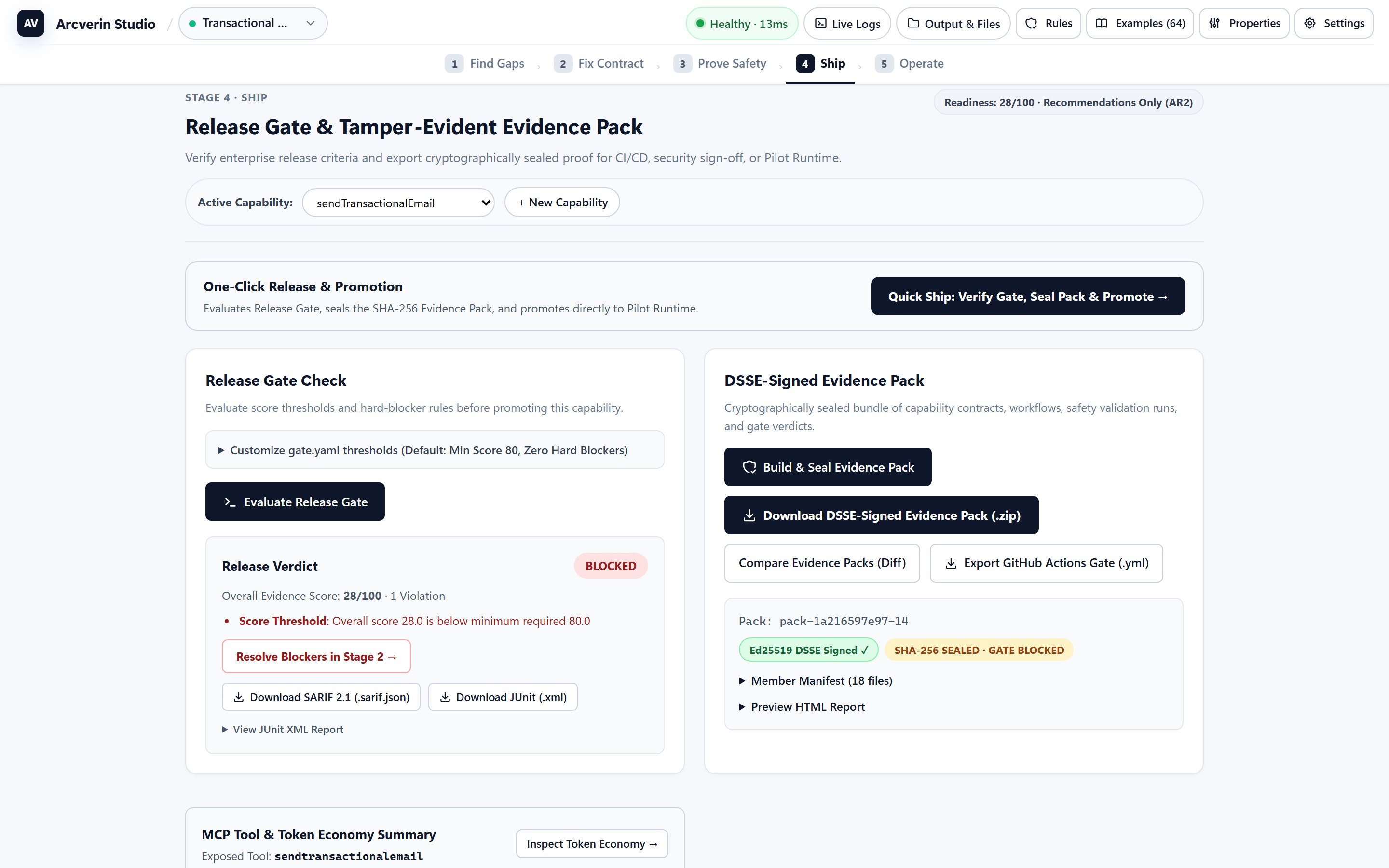
10Enforce fail-closed release gates and seal an Ed25519 DSSE Pack
Executed Stage 4 Release Gate and signed Evidence Pack on Transactional Mail Service.
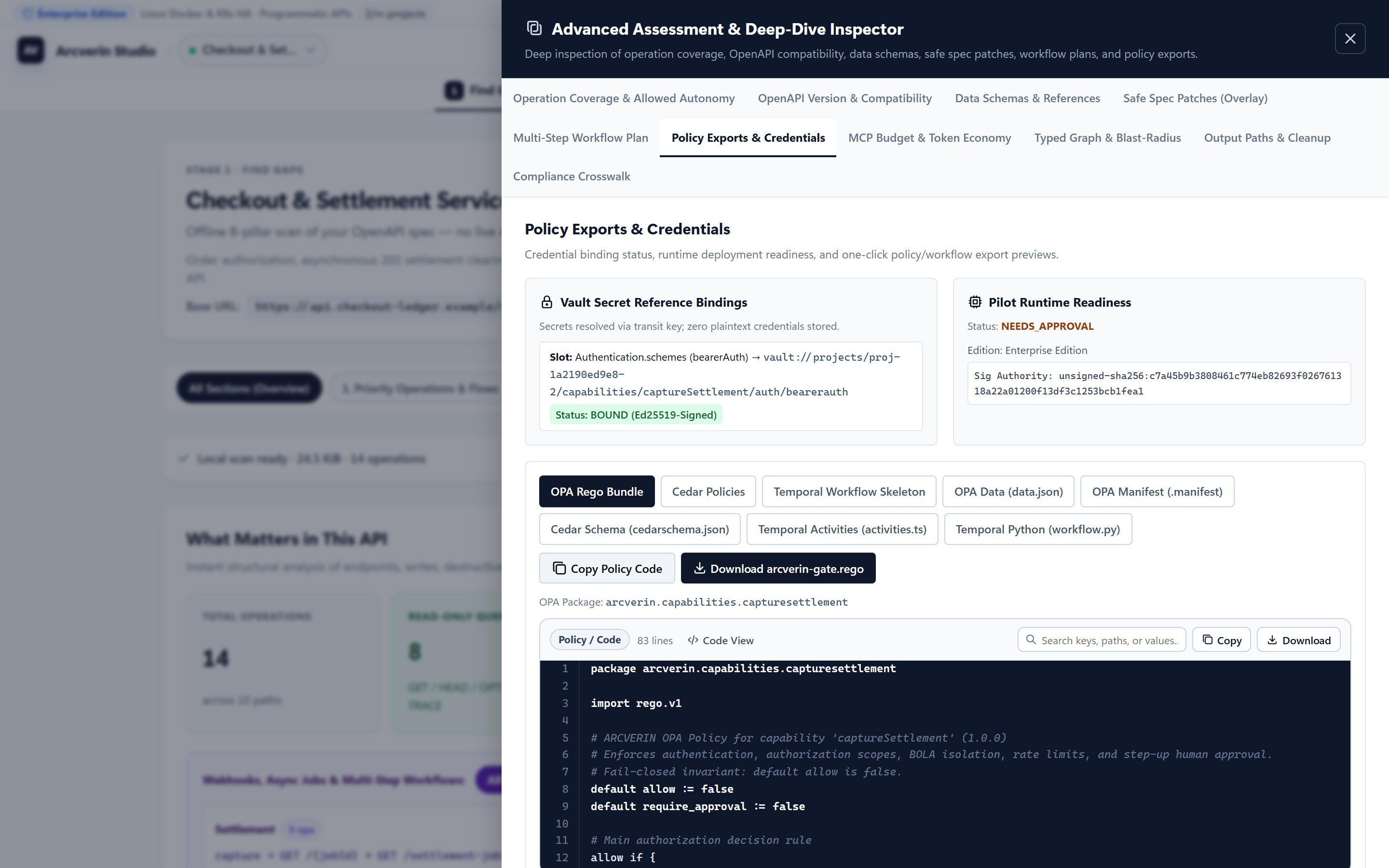
Open full image ↗Actual Arcverin Studio interface · Executed 4. Ship showing fail-closed gate.yaml verdict (intentionally BLOCKED at 28/100 below the 80.0 minimum threshold), CI-ready SARIF / JUnit downloads, and cryptographically signed Ed25519 DSSE Evidence Pack (plus OPA Rego, AWS Cedar & Temporal exports).
Do
Evaluate your gate.yaml policy to confirm thresholds fail closed when blockers remain, or click Quick Ship: Verify Gate, Seal Pack & Promote → once passing.
Download SARIF 2.1.0, JUnit XML, portable Arazzo 1.1 / OPA / Cedar / Temporal exports (including Team runnable TS/Python project bundles and Enterprise Multi-System Temporal Sagas), and your offline-verifiable Ed25519 DSSE Evidence Pack.
See
4. ShipFail-Closed gate.yaml VerdictDownload SARIF / JUnitEd25519 DSSE Signed ✓OPA / Cedar / Temporal Exports
Meaning
Stage 4 turns ad-hoc security sign-off into a tamper-evident CI artifact bundle verified offline via arcverin pack verify—preventing unhardened capabilities from reaching production agents.
Check before continuing
Verify Evidence Pack digests offline and export gateway bundles (Kong, Azure APIM, Envoy, AWS Bedrock AgentCore) as needed.
Next
Open the Enterprise Compliance Crosswalk tab to inspect automated 6-framework regulatory control mapping.
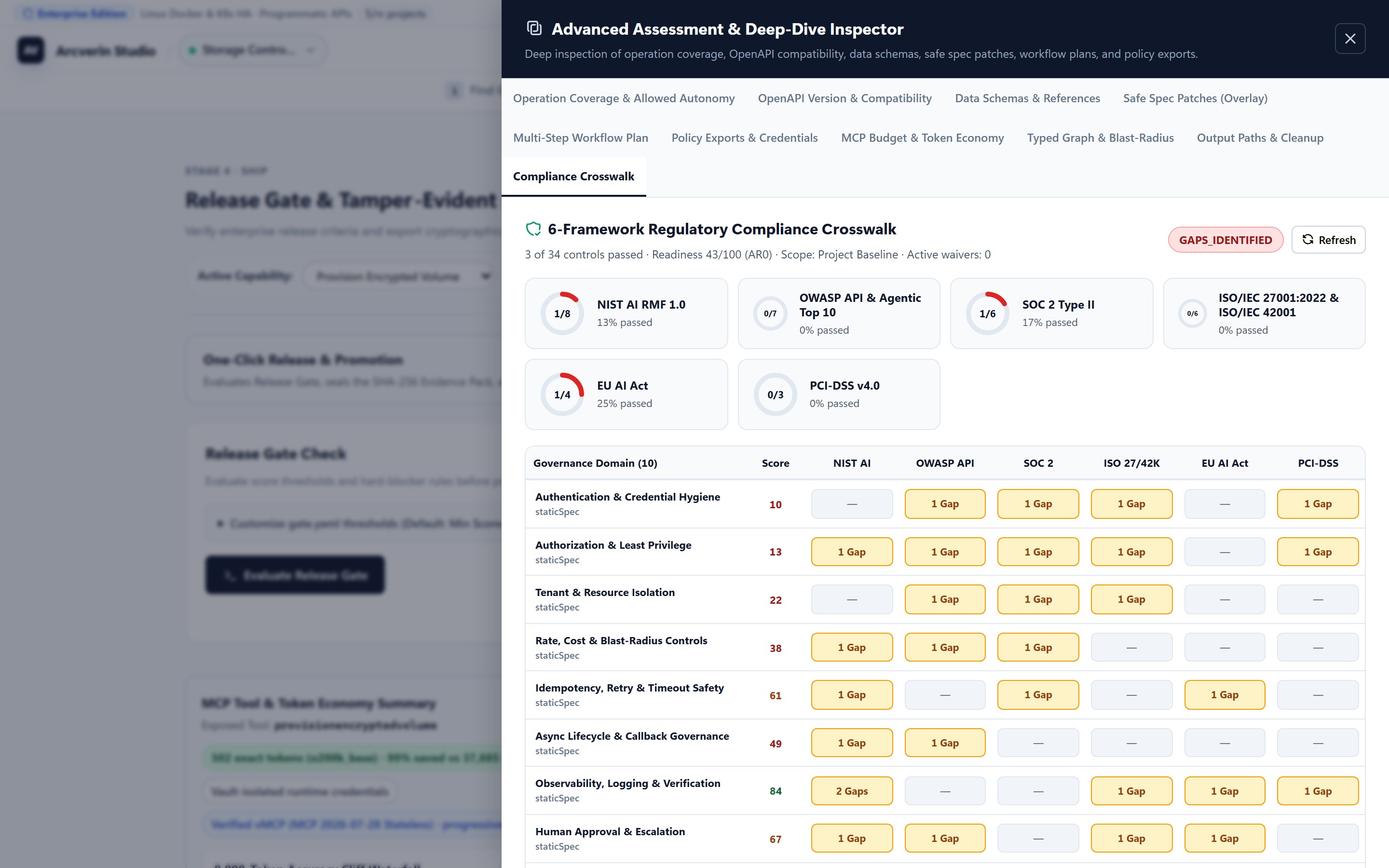
11Map deterministic checks across 6 regulatory frameworks
Enterprise Edition Compliance Crosswalk heatmap on Storage Control Plane API.
Open full image ↗Actual Arcverin Studio interface · 6-Framework Regulatory Compliance Crosswalk translating deterministic 8-pillar findings into per-control gap matrices for security and compliance auditors.
Do
Open Properties → Open Full 9-Tab Exports → Compliance Crosswalk (10 tabs on Enterprise; inspectable across Stages 1–4) to review pass/gap rings across all 6 enterprise standards and all 10 governance domains.
Trace each domain row (Authentication, Authorization, Isolation, Blast Radius, Idempotency, Async Lifecycle, Verification, Approval) directly to framework control gaps and include the crosswalk in your signed DSSE Pack.
See
NIST AI RMF 1.0OWASP API & Agentic Top 10SOC 2 Type IIISO/IEC 27001:2022 & 42001EU AI ActPCI-DSS v4.0
Meaning
Security and GRC teams get an auditable, evidence-backed mapping from technical OpenAPI checks to compliance controls—never a generic marketing checklist, and always honest about open gaps.
Check before continuing
Compliance crosswalks fail closed until validation runs and release gates pass; they document tested technical controls and complement—never replace—formal legal certification.
Next
Promote your verified capability into 5. Operate to run under dual-control runtime governance.
5. Operate — Operations & Pilot Runtime
Run promoted capabilities in Pilot Runtime across Personal Edition (single-host Windows x64 & Linux Ubuntu 26.04 x64 workstation), Team Edition (shared Docker & Kubernetes with PostgreSQL 15–18 and OpenTelemetry OTel / OTLP audit log export), and Enterprise Edition (Kubernetes with HA Control Plane, HPA Runner, single-writer Runtime/Vault pod, PostgreSQL 15–18 FORCE RLS across 15 workspace tables, vMCP, token-authenticated Splunk HEC & OTel/OTLP streaming, and software CMK Ed25519 signing with key-URI provenance).
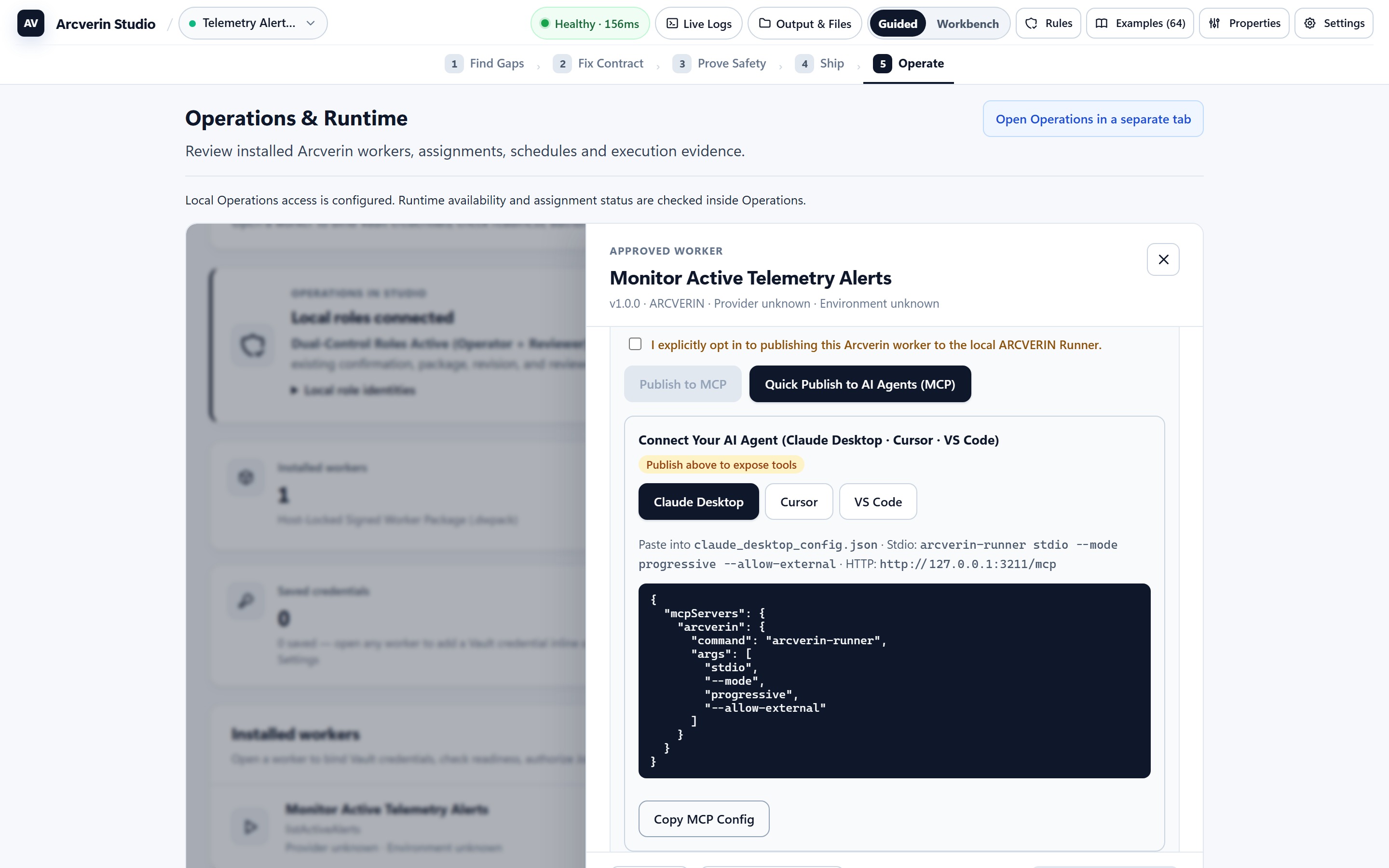
12Bind Vault secrets and connect Claude, Cursor, or VS Code in 1 click
Arcverin Studio Stage 5 running with managed Vault, Commissioning, Pilot Runtime, and MCP Runner services.
Open full image ↗Actual Arcverin Studio interface · 5. Operate console with an installed Host-Locked Signed Worker Package (.dwpack), the 3-Step Readiness Checklist, inline Vault credential binding, and 1-click Claude Desktop, Cursor, and VS Code MCP client configuration.
Do
Promote a verified capability from Stage 4 or click Import approved worker to load a Host-Locked Signed Worker Package (.dwpack).
Complete the 3-step readiness checklist (Connect Service & Bind Vault → Check Readiness & Run → Publish to AI Agents via Stateless MCP) and copy ready-to-paste client configs for Claude Desktop, Cursor, or VS Code.
See
5. Operate · Approved Worker3-Step Readiness ChecklistInline Vault Credential BindingConnect Your AI Agent (Claude · Cursor · VS Code)Operator & Reviewer Governance
Meaning
5. Operate keeps every promoted worker disabled until Vault credentials are bound, the Execution Policy Gate is configured, and Operator/Reviewer governance (plus N-of-M multi-party quorum on Enterprise) approves publication. Pilot Runtime serves Progressive 1-2-3 MCP (arcverin_discover → arcverin_describe → arcverin_invoke) and records SHA-256 hash-chained receipts.
Check before continuing
Runtime credentials remain encrypted locally inside arcverin-vault using Argon2id + XChaCha20-Poly1305 AEAD (or HashiCorp Vault KV v2 on Enterprise) and never enter LLM prompts.
Next
Explore the additional Overlay, Team RBAC, Cross-Provider vMCP, and Gateway screens below, or download the 5-Lane Quickstart Kit (.zip).
Additional Verified Product Screens
Overlay Diffs, Team RBAC & API Keys, Cross-Provider vMCP, and Gateway Exports
Inspect four additional live Studio screens covering zero-rewrite OpenAPI 1.2.0 repairs, workspace RBAC & scoped ak_live_... tokens, multi-API vMCP composition, and gateway/policy exports.
Stage 2 · Non-Destructive Repair
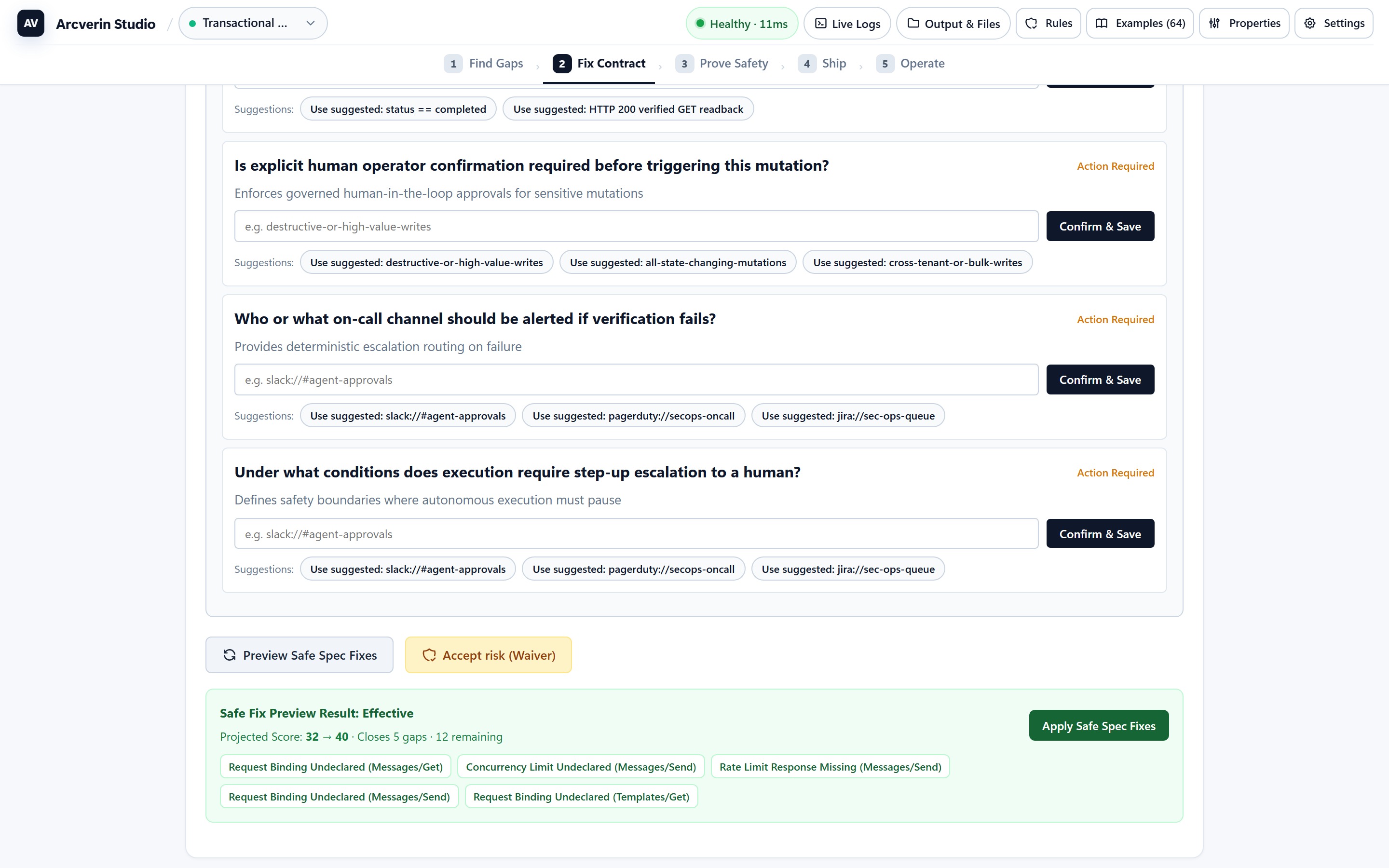
OpenAPI 1.2.0 Safe Fix Preview & Waivers
Preview exact score uplift and closed findings before applying non-destructive OpenAPI 1.2.0 Overlays, or record SHA-256 spec-bound expiring waivers.
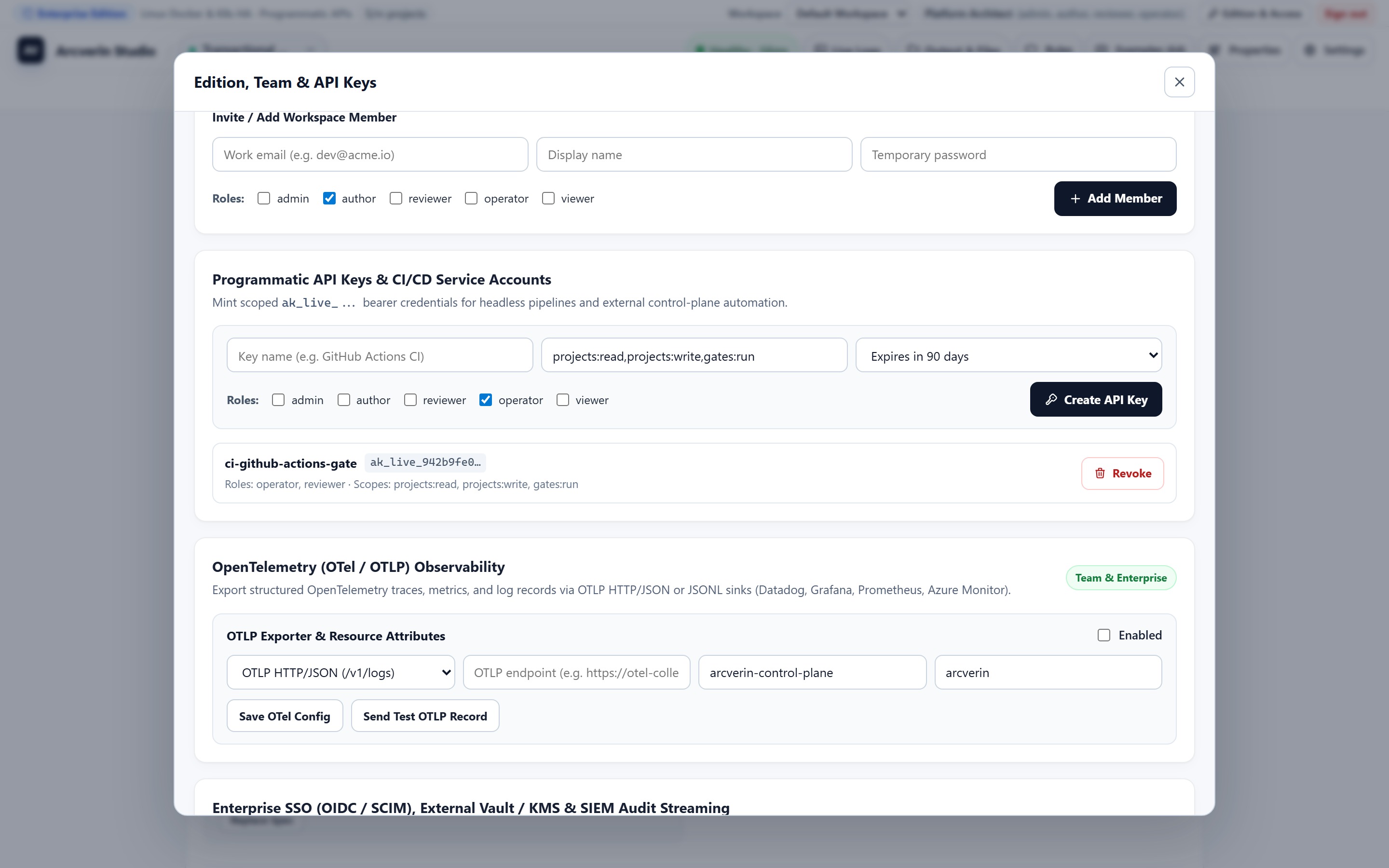
Team & Enterprise · Access & CI Tokens
5-Role RBAC, Quota Meters & Scoped API Keys
Manage Admin, Author, Reviewer, Operator, and Viewer roles and mint scoped ak_live_... tokens for CI release gates and HTTP MCP.
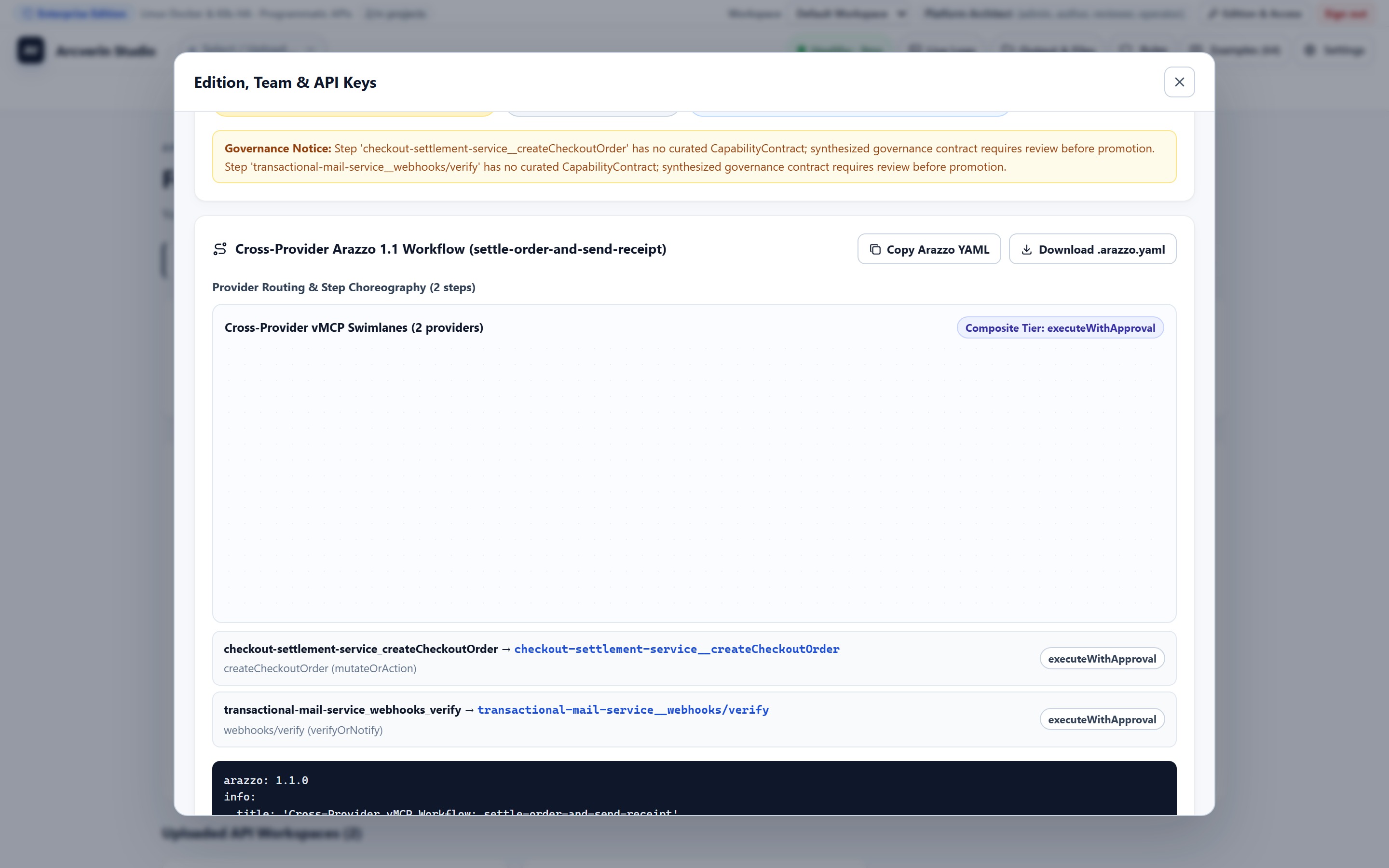
Enterprise · Multi-System Orchestration
Cross-Provider vMCP & Arazzo 1.1 Composer
Combine multiple internal APIs and MCP servers into a single deterministic .arazzo.yaml + .vmcp.yaml workflow DAG with strictest-tier autonomy inheritance.
Stage 4 · Edge & Policy Interop
10-Tab Gateway, Drift & Policy Exports
Export portable Arazzo 1.1 workflows, OPA Rego, AWS Cedar, Temporal skeletons, Team runnable Temporal TypeScript/Python project bundles, Enterprise Multi-System vMCP → Temporal Sagas, and API Gateway bundles (Azure APIM, Kong, Envoy, AWS Bedrock AgentCore) with zero lock-in.
CLI & Commissioning Workflows
Automate assessment, validation, export, and commissioning
Use these documented CLI workflows alongside Studio for CI pipelines and Pilot Runtime promotion across Personal, Team, and Enterprise Editions.
CLI & CI pipelines
Assess, compile, validate, and export from the CLI
Before you begin: An OpenAPI 2.0/3.0/3.1/3.2 specification file.
Assess specs locally or in CI with arcverin qualify <spec>, arcverin qualify readiness <spec> --capability <contract> --scorecard-out <file>, arcverin qualify scan <spec> -o <dir> --arazzo --export-arcverin-handoff, and arcverin mcp-economy <spec> (Raw, Selective Read-Only, and Curated token tiers).
Run 23 stateful scenarios (async 202 polling across POST/PUT/PATCH/DELETE/GET) and 12 fault-injection modes in mock or staging via arcverin validate --target mock|staging (add --read-only for non-mutating runs, or --export / --import for digest-bound validation).
Check your edition with arcverin status (Active Edition) and activate or upgrade via arcverin upgrade --license <path> or ARCVERIN_LICENSE_KEY (ARCVERIN-<EDITION>-<base64>).
CLI commands mirror Studio's Stage 1–4 flow deterministically with zero live production calls. Use arcverin gate --policy gate.yaml (--junit / --sarif) and arcverin pack build --signing-key / pack verify --trusted-signers to emit DSSE Evidence Pack v1 artifacts (plus CMK Ed25519 signing with key-URI provenance and Compliance Crosswalks in Enterprise).
Promotion & 5. Operate
Promote and commission a reviewed capability for Pilot Runtime
Before you begin: Arcverin Studio (Personal, Team, or Enterprise Edition) with managed Vault, Commissioning, and Pilot Runtime services.
Promote gated capabilities via 4. Ship's 1-click Quick Ship: Verify Gate, Seal Pack & Promote → flow or arcverin-commissioning submit.
Complete the 3-Step Readiness Checklist in 5. Operate (or approve/reject via arcverin-commissioning under dual operator and reviewer control).
Bind Vault credentials, verify the Execution Policy Gate and hash-chained journal (arcverin-runner verify-journal --journal-path ...) in arcverin-runner serve or stdio (--mode eager [default] or --mode progressive --compat-mcp for Claude Desktop, Cursor, or VS Code), and stream OTel / OTLP telemetry in Team & Enterprise (plus vMCP, Gateway Policies, Drift Governance, and SIEM/CMK provenance in Enterprise).
Each promoted artifact is a Host-Locked Signed Worker Package bound to its target Pilot Runtime host. Promoted workers stay disabled until explicitly configured with inline Vault bindings and authorized for MCP publication.
Return to the decision you need to make.
Start with Personal Edition ($99 1-Month Pass or $49/mo billed annually · $588/yr; Windows x64 ZIP or Linux Ubuntu 26.04 x64 tar.gz) to run the 1. Find Gaps → 2. Fix Contract → 3. Prove Safety → 4. Ship → 5. Operate workflow locally. Then verify your active Personal license to upgrade to Team or Enterprise on Docker & Kubernetes.