Arcverin Enterprise Edition · Multi-Domain Verified Virtual MCP (vMCP)

Orchestrate 7 Enterprise Systems in One Governed AI Call — Zero Credential Sprawl, -98.4% Tool Tokens.

Pick any 7 enterprise domains from your API and MCP catalog. Arcverin compiles them into one Verified Virtual MCP server and one deterministic Arazzo 1.1 workflow — eliminating the 8,000-token accuracy cliff, enforcing four-eyes human approval (AR2), and permanently stripping catastrophic admin endpoints.

Validated end-to-end on Arcverin Enterprise Edition (Kubernetes + PostgreSQL 15–18 RLS, tested on PG 18 + CMK DSSE Packs + External OPA PDP) using deterministic synthetic vendor-neutral enterprise servers.

7 Mounted Enterprise Domains · 44 Composed Tools -98.4% Upfront

18,913 Eager Tokens → 308 Progressive Tokens

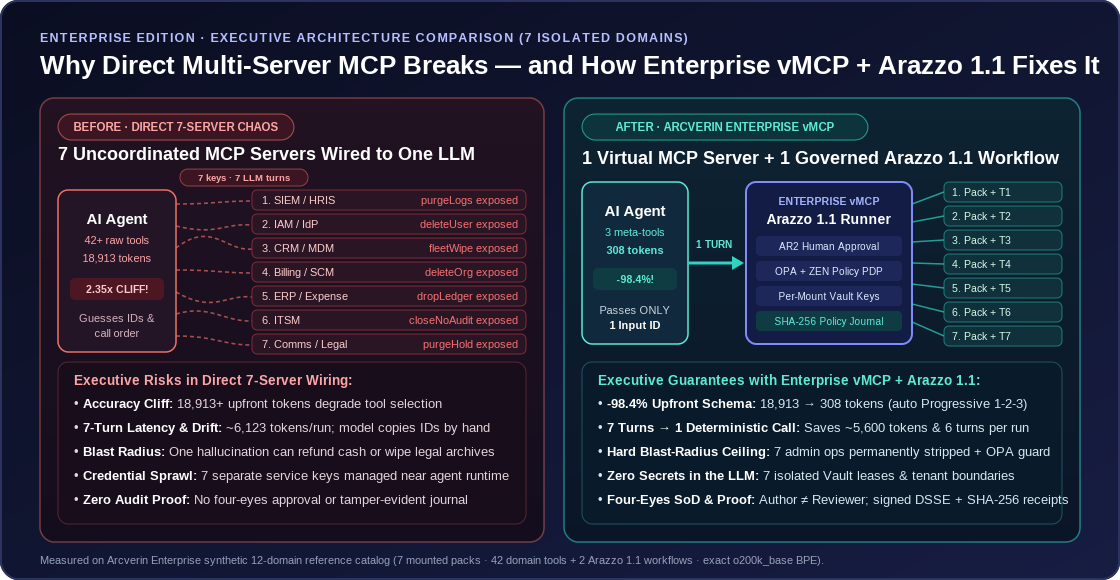
Mounting 7 enterprise MCP servers directly puts 18,912–18,913 exact o200k_base BPE tokens into the model context (2.36× past the 8,000-token accuracy cliff). Enterprise vMCP auto-switches to 3 meta-tools (308 tokens) and collapses 7 LLM turns into 1 governed Arazzo 1.1 call.

1. arcverin_discover 2. arcverin_describe 3. arcverin_invoke
Pick Any 7 Domains Compose OpenAPI specs, external MCP servers & Arazzo workflows
7 Turns → 1 Call Auto-wired Arazzo 1.1 relay saves ~5,600 tokens & 6 LLM turns/run
Zero Credential Sprawl 7 isolated per-mount Vault leases & tenant headers never touch the LLM
Four-Eyes SoD & OPA AR2 approval, Author ≠ Reviewer promotion & SHA-256 Policy Journal
30-Second Executive Summary — The Enterprise AI Coordination Problem, Solved:

Real enterprise work never happens inside one application. Containing a compromised account or offboarding a departing employee touches 7 separate systems — owned by different teams, with different permissions, credentials, and legal rules. Wiring an AI agent directly to 7 raw MCP servers floods the model with 18,900+ tokens of schemas, burns 7 error-prone LLM turns, exposes 7 credentials near the agent, and leaves destructive admin endpoints one mistake away. Arcverin Enterprise vMCP + Arazzo 1.1 collapses all 7 servers into one verified endpoint that passes a single ID (alertId or employeeId), pauses for verified human approval before mutating state, blocks prohibited actions deterministically, and produces tamper-evident audit receipts.

-98.4% Upfront Tool Schema Bloat 18,913 → 308 exact BPE tokens across 7 mounted servers via Auto Progressive 1-2-3.
7 → 1 Turn Deterministic Arazzo Relay 6 LLM round-trips cut (~5,556–5,604 tokens saved/run); zero LLM ID copy-paste errors.
0 Secrets Exposed to the AI Model Each of the 7 mounted domains uses its own isolated tenant boundary and Vault lease.
7 / 7 Blocked Admin Endpoints Stripped Destructive admin operations are removed fail-closed before an agent ever sees them.

Executive Architecture Insight

Without vs. With Arcverin Enterprise vMCP Across 7 Systems

At a glance: why scaling enterprise AI from 1 API to 7 cross-functional systems requires a governed Virtual MCP layer and deterministic Arazzo 1.1 workflows rather than raw MCP server sprawl.

Side-by-side architecture visual comparing direct 7-server MCP chaos (42+ raw tools, 18,913 tokens past the 8,000-token cliff, 7 credentials, 7 LLM turns, exposed admin ops) against Arcverin Enterprise vMCP (1 virtual endpoint, 3 meta-tools at 308 tokens, -98.4% reduction, 1 Arazzo 1.1 turn, isolated Vault mounts, AR2 human approval, and OPA policy enforcement).
Synthetic reference disclosure: Exact o200k_base BPE token counts measured on Arcverin’s 12-domain vendor-neutral synthetic Enterprise catalog (acme_*, 6 governed capabilities + 1 stripped admin op per domain). Figures measure MCP tool-description and workflow orchestration payloads on synthetic test backends, not live third-party SaaS SLAs or customer invoices. Download SVG graphic
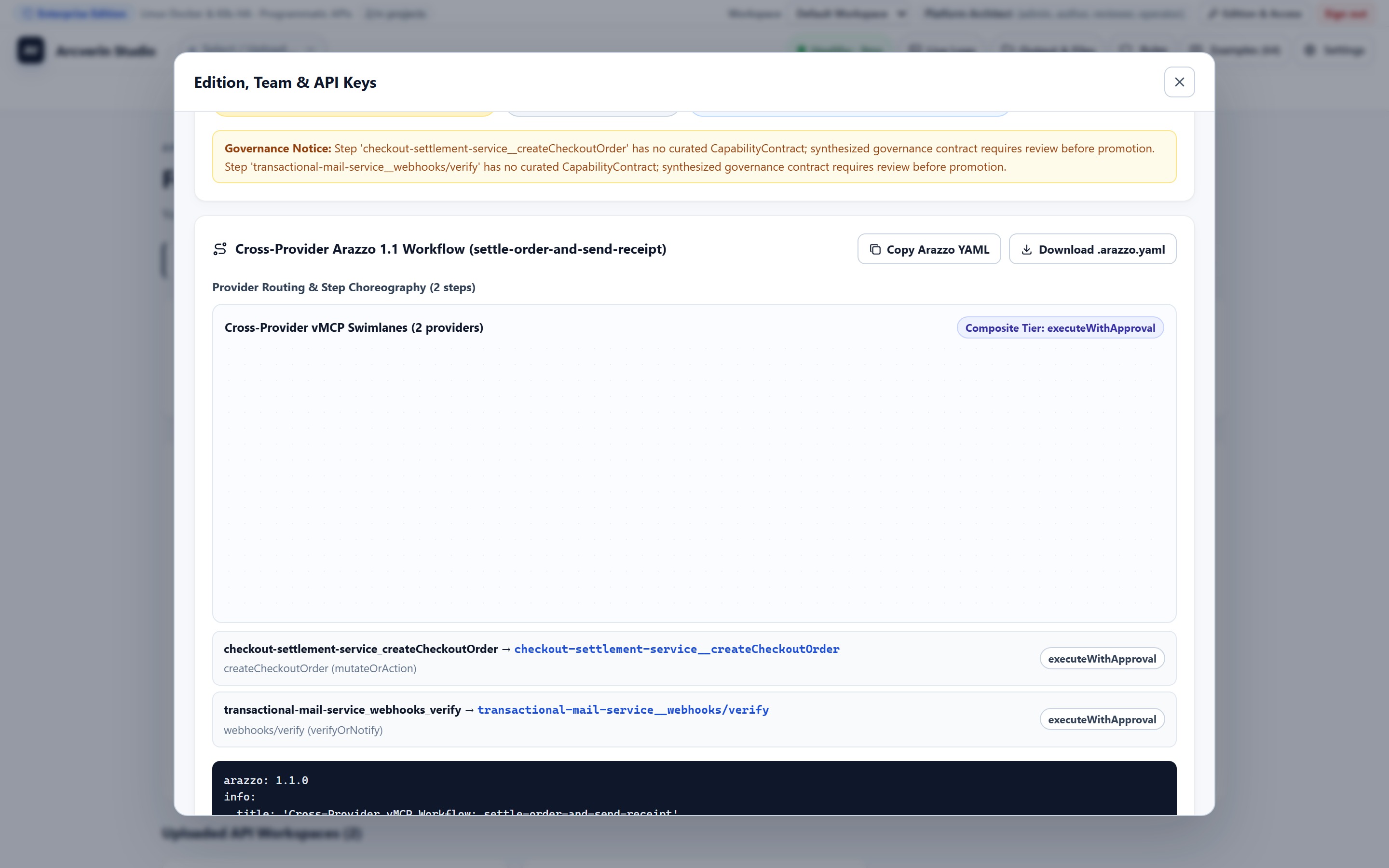
Arcverin Studio Enterprise Cross-Provider vMCP Composer synthesizing a multi-API Arazzo 1.1 and vMCP workflow DAG with composite autonomy tier clamping and o200k_base token compaction.
Actual Studio interface (Edition & Access → Cross-Provider vMCP): Select two or more governed workspace APIs or external MCP servers, describe the business outcome, and synthesize a deterministic cross-provider .arazzo.yaml + .vmcp.yaml DAG with strictest-tier autonomy inheritance. Inspect in Studio Visual Guide

Two Flagship Executive Blueprints · Built & Validated End-to-End

Explore Option A and Option B in Full Detail

Both blueprints run across 7 distinct enterprise domains from a single input identifier, share real cross-cutting services (IAM and ITSM), and prove 3 acts: safe read-only triage, approval-gated execution, and fail-closed defense against unauthorized or catastrophic actions.

Option A · CISO, Fraud & Revenue Operations

Account Compromise Triage & Containment

Executive Problem: A critical SIEM alert flags a hijacked VIP customer login with a $4,850 suspicious order already picking in the warehouse. Seconds matter — yet revoking sessions, holding payments, and halting shipments without issuing an unauthorized refund spans 7 departments.

1. SIEM 2. IAM (AR2) 3. CRM 4. Billing (AR2) 5. ERP 6. ITSM 7. SOC Comms
  • Single input (alertId): Downstream IDs (principalId, customerId, chargeId, orderId, ticketId) flow automatically via Arazzo 1.1 bindings.
  • Measured economy: 18,913 → 308 upfront BPE tokens (-98.4%); 6,123 → 519 tokens per containment run (5,604 saved · 6 turns cut).
  • Hard boundary proof: Unapproved containment hits 0 backends; prohibition do not refund dispute blocks unauthorized refunds; 7 admin ops (e.g. purgeSecurityLogs, overridePayoutBank) stripped permanently.

Option B · CIO, CHRO, IT Ops & General Counsel

Employee Offboarding & Legal-Hold Preservation

Executive Problem: Offboarding carries two opposite executive risks: leaving an ex-employee with live code/card access (security breach) or accidentally wiping a laptop or mailbox under active litigation hold (court spoliation sanctions).

1. HRIS 2. IAM (AR2) 3. MDM (AR2) 4. SCM (AR2) 5. Expense 6. ITSM 7. Legal Hold
  • Single input (employeeId): HRIS surfaces legalHoldFlag: true and auto-wires principalId, deviceId, cardId, and legalHoldId across all 7 systems.
  • Measured economy: 18,912 → 308 upfront BPE tokens (-98.4%); 6,079 → 523 tokens per offboarding run (5,556 saved · 6 turns cut).
  • 2-Layer Anti-Spoliation Shield: Synthesis enforces do not delete mailbox and runtime External OPA denies delete_mailbox_archive even if a human approval token is presented; 7 admin ops (e.g. factoryResetAllFleet, purgeLegalHoldArchive) stripped.

Zero Hardcoding · Composable 12-Domain Catalog

Pick Any 7 Domains — See How Enterprise vMCP Composes Them

Arcverin does not hardcode Option A or Option B. Choose a flagship preset or click any combination of the 12 synthetic enterprise domains below (including heterogeneous mixes of OpenAPI projects, external MCP servers, and Arazzo workflows) to see how Enterprise vMCP calculates the accuracy cliff, autonomy ceiling, and stripped admin operations.

Mounted Domains 7 / 12 domains selected
Composed Surface 42 governed tools (+2 Arazzo workflows)
MCP Token Footprint 18,913 eager → 308 progressive (-98.4%)
Composite Tier & Mode AR2 Execute with Human Approval

Option A · Account Compromise Triage & Containment — Single-turn Arazzo 1.1 (account_compromise_containment_7d) with prohibition: "do not refund dispute".

Permanently Stripped Admin Operations (fail-closed): purgeSecurityLogs · deleteDirectoryUser · exportAllCustomerPii · overridePayoutBank · dropLedgerTable · closeWithoutAudit · broadcastAllEmployees

Mode selector: Auto Progressive 1-2-3 (Crosses 8,000-token cliff). Also validated for heterogeneous 7-provider mixes combining 5 OpenAPI projects + 1 external MCP server + 1 external Arazzo 1.1 workflow.

Arazzo 1.1 Cross-Provider Compiler · Enterprise Edition

How Virtual MCP (vMCP) Works Under the Hood

Under the hood, vMCP builds on Arazzo 1.1, whose sourceDescriptions model natively references multiple OpenAPI and AsyncAPI documents, anchors cross-document links with $self, extracts fields across steps with Selector Objects (jsonpath, xpath, jsonpointer), chains reusable sub-workflows, and coordinates non-linear execution via dependsOn. Arcverin compiles those cross-provider DAGs into a unified WorkerIr and serves them through arcverin-runner serve --vmcp-profile (or arcverin-runner serve-vmcp), with Enterprise Control-Plane automation via compose-and-promote-vmcp.

Three mechanics that distinguish vMCP from a simple multi-server MCP aggregator

1 · Compaction

Domain-outcome compaction

Instead of exposing individual atomic endpoints from three to seven separate services, vMCP collapses the cross-system call sequence behind one coarse-grained capability tool (paired with Auto Progressive 1-2-3 meta-tools), keeping underlying operations hidden from the model.

2 · Monotonic Safety

Strictest-tier autonomy inheritance

When a composed workflow spans providers with different risk profiles—for example, a read-only AR1 lookup combined with a mutating AR2 action requiring human sign-off—the compiled vMCP capability inherits the strictest autonomy tier across the chain (and stays blocked if any step is AR0).

3 · Credential Isolation

Per-provider Vault isolation

arcverin-runtime injects distinct credentials for each upstream API out-of-band during step execution so the AI agent never holds tokens, API keys, or session secrets for any participating backend.

Why multi-domain operations break without a virtual composition layer

Compound tool bloat

Connecting five domain MCP servers with 30 endpoints each immediately puts 150 raw tools into context—pushing models past the >50-tool / 8,000-token selection accuracy cliff before reading the user prompt.

The LLM becomes fragile glue

Without declarative Arazzo bindings, the model has to copy IDs from System A to System B through its context window, burn tokens carrying bulky intermediate payloads, and improvise retries or ordering when a downstream API stalls.

Fragmented security boundaries

Enforcing a unified tenant boundary, rate cap, audit trail, or human-approval gate across several independent MCP servers becomes brittle and ad hoc. vMCP moves cross-domain wiring into a deterministic composition layer without forcing teams to build and maintain a custom Backend-for-Frontend (BFF) microservice for every new workflow.

Honest Architectural Boundaries · Build vs. Compose

Where vMCP Has Real Limits — and When You Can Skip It

Pre-compiled cross-provider DAGs are built for repeatable, high-consequence operational procedures. Knowing where vMCP stops helps platform teams choose the right layer for each workload.

Three real architectural and licensing boundaries

1. No automatic distributed transactions or 2PC: OpenAPI and Arazzo 1.1 describe call sequences, dependencies, and error actions—not distributed two-phase commit (2PC). If Step 1 commits a mutation on Provider A and Step 2 fails permanently on Provider B, Arcverin cannot invent backend rollback logic that your APIs do not expose; you author explicit compensating endpoints and either execute them in-flow or export an Enterprise Multi-System vMCP → Temporal Saga bundle (export-only TypeScript & Python .zip with LIFO compensation hooks, N-of-M SoD quorum approvals, and per-provider Vault/OPA hooks that runs on your own Temporal workers).

2. Enterprise-only fail-closed gating: Cross-provider vMCP and Control-Plane compose-and-promote-vmcp sit strictly behind Enterprise Edition (Inquire for Pricing), returning HTTP 403 (verifiedVmcpRequiresEnterprise) on Personal and Team deployments. Teams validate single-API workflows locally on Personal Edition ($99 1-Month Pass / $49/mo billed annually · $588/yr) before licensing Enterprise for multi-provider composition.

3. Rigid for open-ended exploratory work: Pre-compiled cross-provider DAGs fit repeatable, auditable operational procedures—not ad hoc investigative queries where an agent needs to dynamically explore arbitrary combinations of systems on the fly.

Good Fit

When vMCP pays off

Use vMCP when exposing a multi-domain enterprise API estate to autonomous or semi-autonomous agents and you need a clean separation between atomic provider APIs, deterministic cross-service composition, and high-level domain outcomes—especially when mutations cross organizational boundaries and Security demands unified OPA/Cedar gating, AR2 human-approval checkpoints, and isolated per-provider Vault credentials.

Skip or Use Another Layer

When you can skip vMCP

Skip vMCP if you already standardize cross-service orchestration in a durable workflow engine (like Temporal) or an internal aggregation/BFF API layer—at that point you already own cross-domain composition and only need to qualify and expose one coarse-grained endpoint to agents. Likewise, for mostly read-only or exploratory workloads, an MCP gateway or Code Mode sandbox provides cross-domain reach with less upfront modeling overhead.

Side-by-Side Executive Comparison

Option A vs. Option B vs. Custom 7-of-12 Composition

Both blueprints demonstrate the exact same Enterprise governance architecture across two different C-suite priorities.

Executive Dimension Option A: Account Compromise Option B: Employee Offboarding Custom 7-of-12 Pick
Primary Stakeholders CISO, SOC Lead, VP Fraud & Revenue Ops CIO, CHRO, IT Ops & General Counsel Security, Internal Audit & Platform Teams
7 Participating Domains SIEM → IAM → CRM → Billing → ERP → ITSM → SOC Comms HRIS → IAM → MDM → SCM → Expense → ITSM → Legal Hold Any 7 of 12 (e.g. Insider Risk: HRIS + SIEM + IAM + MDM + SCM + ITSM + Legal)
Single Model Input alertId (e.g. ALT-2026-9042) employeeId (e.g. emp_20419) Auto-derived minimal inputs only
Upfront MCP Tokens (o200k_base) 18,913 → 308 (-98.4% · Auto Progressive) 18,912 → 308 (-98.4% · Auto Progressive) Crosses 8,000 cliff → Auto Progressive 308
Per-Run Workflow Savings Act 1: 5,808 → 456 · Act 2: 6,123 → 519 (-5,604 · 6 turns cut) Act 1: 5,813 → 459 · Act 2: 6,079 → 523 (-5,556 · 6 turns cut) 7 turns collapsed into 1 deterministic call
Signature Boundary Proof Unapproved containment hits 0 backends; do not refund dispute enforced 2-Layer Anti-Spoliation: do not delete mailbox + OPA hard-denies even if approved Prohibitions + 7 stripped admin ops + SoD backlog promotion
Deep-Dive Page Open Option A Details Open Option B Details Headless Control-Plane API

Validate Multi-Domain vMCP on Your Own 7 APIs with Enterprise Edition

Start with Personal Edition ($99 1-Month Pass or $49/mo billed annually · $588/yr) to test your first API locally, then request a custom annual quote for Enterprise Standard or Enterprise Unlimited + Sovereign Source with our 3-Year Founding Launch Rate Lock.